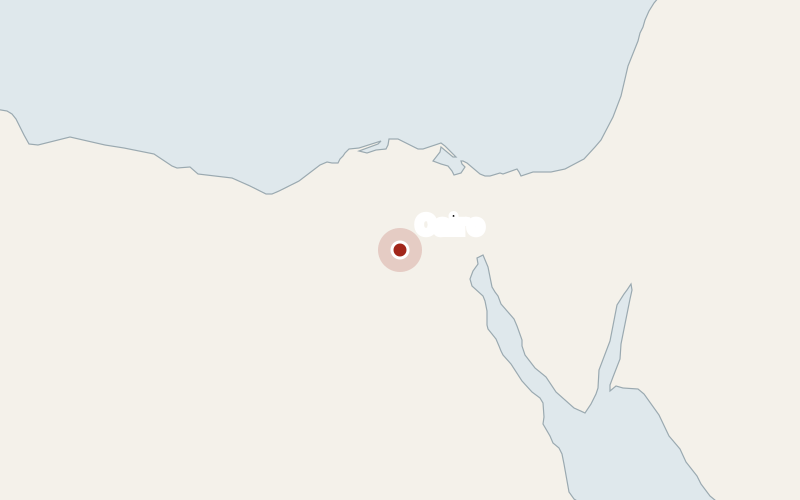
Bronze Age · 13th century BC · Tell El-Faraoun (Imet), Sharqia Governorate, Egypt
Upper half of colossal Ramesses II statue found in Egypt's Nile Delta
The five-to-six-ton figure was probably carved in the royal capital Pi-Ramesse and later moved to Imet for reuse in a local temple.

Official announcement
Tell El-Faraoun (Imet), Egypt An Egyptian archaeological mission has found the upper half of a massive stone statue in Egypt's eastern Nile Delta. The site is Tell El-Faraoun in Sharqia Governorate. According to Egypt's Ministry of Tourism and Antiquities and the Supreme Council of Antiquities (SCA), the statue is thought to depict Ramesses II. He reigned around 1279–1213 BC.
The ministry and the SCA also say the statue was brought to the site from elsewhere. It was reused there in antiquity.
The surviving section is about 2.2 metres tall (Archaeology Magazine gives seven feet). It is estimated to weigh between five and six tons. The lower part of the statue, with the legs and base, is missing.
The stone is poorly preserved. But according to the ministry, it keeps royal and artistic features that point strongly to Ramesses II. He was one of the most prolific builders among Egypt's kings.
Thought to come from Ramesses II's capital
Tell El-Faraoun, also written Tel Faraoun, was known in antiquity as Imet. Preliminary studies indicate that the statue did not originate there. The researchers think it was made in Pi-Ramesse (also written Per-Ramesses), the capital Ramesses II founded in the eastern Delta. They think it was later transported to Imet to be reused in a local temple complex.
Hisham El-Leithy, Secretary-General of the SCA, said the find gives evidence of religious and royal activity in the eastern Delta. He said it also gives evidence of the practice of moving monumental statues from one site to another.
The find provides valuable evidence of how statues were relocated and repurposed during the New Kingdom, particularly in regional centers connected to major royal capitals.
Hisham El-Leithy, Secretary-General of the Supreme Council of Antiquities, as reported by Ahram Online
The statue may originally have belonged to a triad, according to Mohamed Abdel-Badii, head of the Egyptian Antiquities Sector. A triad is a sculptural group that typically shows a king flanked by deities. Similar triads have been found at other archaeological sites in Sharqia, which supports the idea. Further research is needed to confirm it.
Archaeology Magazine, citing Ahram Online, attributes the triad suggestion to El-Leithy. It reports him as saying the statue was likely part of a group of three statues. In this account, the group originally stood in a temple in Per-Ramesses.
The statue follows another find at Tell El-Faraoun. In September, archaeologists at the site found a stone stela carrying a new version of the Canopus Decree. The decree was issued in 238 BC under Ptolemy III.
The decree honoured the king and his family. Copies were distributed to major Egyptian temples. The two finds come from periods roughly a thousand years apart.
Restoration and tests on the stone
After the find, the authorities moved the statue from the excavation to the storage facility at San El-Hagar. Specialists there are to begin urgent restoration work.
San El-Hagar is the site of ancient Tanis. In that city, later kings set up many statues and blocks of Ramesses II taken from Pi-Ramesse.
Specialists are also analysing the stone and the carving techniques. According to the ministry, these studies aim to establish the statue's precise age and origin. They also aim to identify the methods its sculptors used.
Sources
- Monumental Statue Unearthed in Northern Egypt (Archaeology Magazine)
- Massive Ramses II Statue Discovered in Egypt’s Nile Delta (Arkeonews)
Spotted a mistake? Tell the editor about a spelling error or a fact that is wrong. We correct stories openly.
Readers' picks show on the front page.
Follow @AncientHeraldHQ on X for the day's finds as they come in.


Comments
House rules. Stay on the subject, be kind to other readers and say where your facts come from. No advertising and no personal attacks. The editor reads along and hides comments that break these rules.
Loading comments…