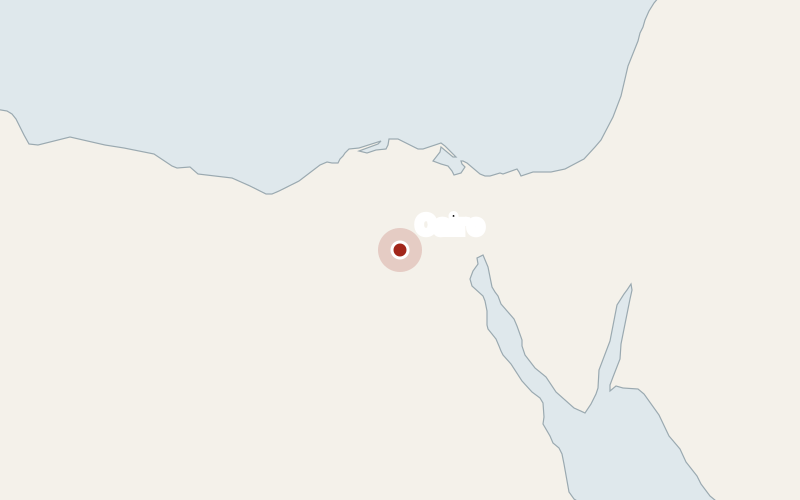
Bronze Age · c. 2280 BC · Saqqara, Giza Governorate, Egypt
Saqqara tomb of official Weni held bronze tools that may be medical
The Old Kingdom official was buried beside King Merenre's pyramid, and although his tomb held the instruments, no inscription in his burial chamber calls him a doctor.

Official announcement
Saqqara, Egypt Egyptian archaeologists have found the tomb of Weni, a high official of the Old Kingdom, beside the pyramid of King Merenre at Saqqara. His burial shaft held several bronze instruments that may have been used for medicine. The inscriptions in his chamber, however, never describe him as a physician.
Egypt's Ministry of Tourism and Antiquities announced the find. The announcement came after the minister, Sherif Fathy, visited the excavation.
An Egyptian mission under the Supreme Council of Antiquities runs the dig. Its head is Amr el-Tibi, director-general of the Saqqara archaeological area. The team works in the cemetery of Merenre in the southern part of Saqqara. Saqqara was the great burial ground of the ancient capital, Memphis.
Merenre was a pharaoh of the Sixth Dynasty and the son of Pepi I. He ruled for roughly a decade around 2280 BC. His pyramid is badly damaged today, but it once stood 52.5 metres tall.
Northwest of the pyramid the team found a mudbrick mastaba. This is a low, long tomb block, and its name comes from the Arabic word for "bench". The structure holds several burial shafts. One of them leads down to an inscribed burial chamber, which belongs to Weni.
A mayor with a title from the far south
The inscriptions survive in relatively good condition. Researchers have therefore been able to read the owner's name and most of his titles. Hisham El-Leithy, secretary-general of the Supreme Council of Antiquities, has set them out.
According to El-Leithy, Weni was "mayor", "sem priest", "director of every royal kilt", "treasurer of the King of Lower Egypt", "sole companion" and "lord of the city of El Kab".
The last title points far to the south. El Kab, ancient Nekheb, lies in Upper Egypt about 80 kilometres south of Luxor. It was the city of the vulture goddess Nekhbet.
The announcement does not say why a man with an official tie to that city was buried in the royal cemetery of the north. Nor does it say whether he travelled between the two places. It also leaves open whether the title was mostly an honour.
The name itself is familiar to Egyptologists. Weni the Elder served under Teti, Pepi I and Merenre. Merenre made him governor of all Upper Egypt.
That Weni's autobiography was carved on a slab in his chapel at Abydos. Auguste Mariette found it in 1860. A team led by Janet Richards of the University of Michigan located his tomb there around 1999.
The ministry does not suggest any connection between the two men. The titles it lists for the Saqqara Weni do not include governor of Upper Egypt. That list is partial, however. La Brújula Verde, which reported the find, considers them most likely two different people.
Possible medical tools, statuettes and a skeleton
Mohamed Abdel-Badie, head of the Egyptian Antiquities Sector, describes the instruments as probably medical. He says such pieces are relatively rare in funerary settings.
The inscriptions do not say Weni was a doctor. For that reason, Abdel-Badie says, the tools' presence in the shaft calls for more research. That research concerns what they were used for and how they relate to the dead man.
Earlier finds give reason for caution. In 2006 the mummy of Qar, a royal physician of the Sixth Dynasty, was announced together with metal instruments. The press presented them as the oldest surgical tools in the world.
It has since been pointed out that miniature tools of this kind turn up in burials of officials with very different jobs. They could therefore be symbolic objects rather than working equipment.
La Brújula Verde notes that an analysis of the alloy in Weni's pieces will matter. The reason is that copper was the metal most often worked in the Old Kingdom.
A small vaulted chamber directly above Weni's held two wooden statuettes in a worshipping pose. The ministry calls them unusual. The announcement does not say whom the figures represent or what gesture they make.
Abdel-Badie says the finds add new information about funerary equipment. They also add information about how each space inside a mastaba was used.
The same structure also produced a false door dedicated to a woman named Sekhet-Nebti. She was a priestess of Hathor. Nothing yet indicates how she was related to Weni.
El-Tibi said the first studies of Weni's skeleton suggest he died after the age of 50. The bones show advanced disease of the teeth and of the tissue around them.
The bones also show changes consistent with physical strain repeated over a lifetime. That is an odd detail for a senior administrator. The announcement does not interpret it.
The mission is continuing its archaeological, architectural, linguistic and artistic studies. The ministry says the skeletal data will be compared with other burials. The aim is to reconstruct how people lived and fell ill at the time.
Sources
Spotted a mistake? Tell the editor about a spelling error or a fact that is wrong. We correct stories openly.
Readers' picks show on the front page.
Follow @AncientHeraldHQ on X for the day's finds as they come in.


Comments
House rules. Stay on the subject, be kind to other readers and say where your facts come from. No advertising and no personal attacks. The editor reads along and hides comments that break these rules.
Loading comments…