Delphi: a pocket guide
Apollo's oracle on a ledge of Mount Parnassus, high above a valley of olive trees
Download the pocket guide PDF for your phone · 1.9 MB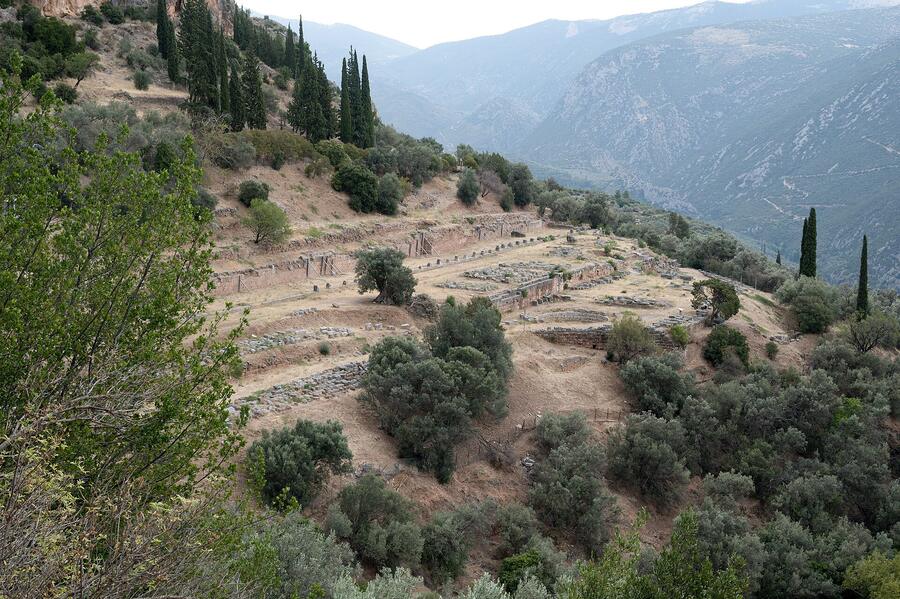
Explore Yourself · No. 04
Delphi
Apollo's oracle on a ledge of Mount Parnassus, high above a valley of olive trees
Ancient Herald pocket guide
At a glance
- Where
- Phocis, Central Greece, Greece; beside the modern village of Delphi
- Period
- 8th century BC to late 4th century AD
- Time to allow
- Half a day for the sanctuary and museum. Allow a full day to add the Sanctuary of Athena Pronaia without hurrying.
- Best time
- Spring and autumn, when the heat is milder and the hills are green in spring. Arrive first thing in the morning: it is cooler, the light is soft and the coach tours from Athens have not yet arrived.
The story
Delphi was the sanctuary of Apollo and the seat of the most famous oracle in the Greek world. It lies on the southern slopes of Mount Parnassus, high above the valley of the Pleistos. Here a priestess, the Pythia, spoke Apollo's answers to questions from cities, rulers and ordinary people. The Greeks believed it was the centre of the world, marked by a stone called the omphalos, or navel.
Cities consulted the oracle before founding colonies or going to war. They thanked the god with treasuries and statues, which crowded the path to the temple. Every four years the Pythian Games brought athletes and musicians to the sanctuary. The ruins climb the hillside in terraces, from the Sacred Way past the temple to the theatre and stadium. Delphi has been a UNESCO World Heritage Site since 1987.
Through time
- 8th century BCOfferings increase sharply as the oracle of Apollo grows into a sanctuary consulted across Greece.
- 582 BCThe Pythian Games are reorganised as a festival for all Greeks, held every four years.
- 548 BCFire destroys the temple of Apollo, and donors from across the Greek world pay for a new one.
- 373 BCAn earthquake wrecks the temple, and the one whose ruins stand today is built in its place.
- Late 4th century ADThe Christian emperor Theodosius I bans pagan cults, and the oracle falls silent.
- 1892The French School at Athens begins large-scale excavation after moving the village of Kastri, which stood on the ruins.
01
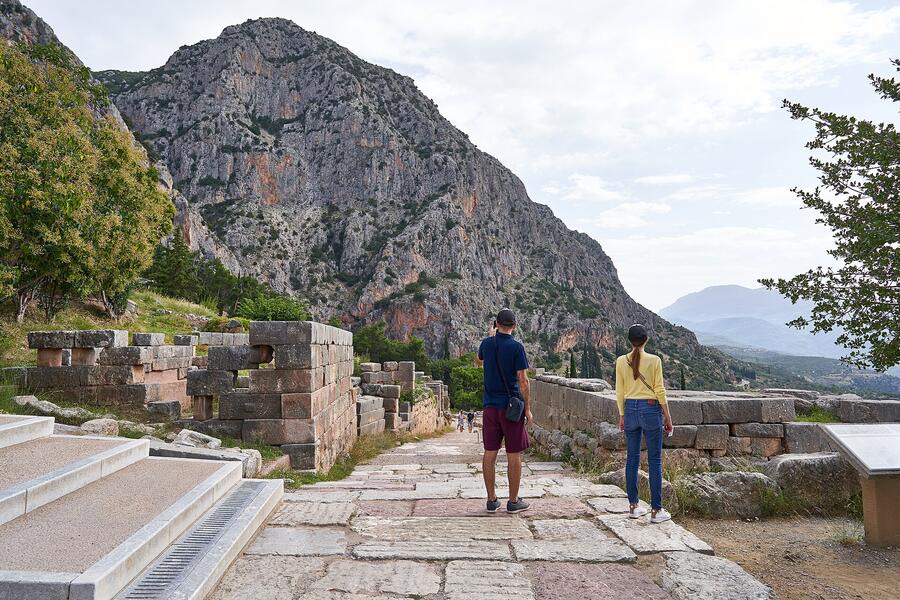
Sacred Way and the Siphnian Treasury
The paved Sacred Way zigzags uphill past the bases of statues and treasuries that Greek cities dedicated to Apollo. The offerings are gone, but many bases still carry their inscriptions. Low on the path are the foundations of the Siphnian Treasury, whose carved frieze from about 525 BC is now in the museum.
Tip The old paving is polished smooth and slippery, so take the climb slowly.
02
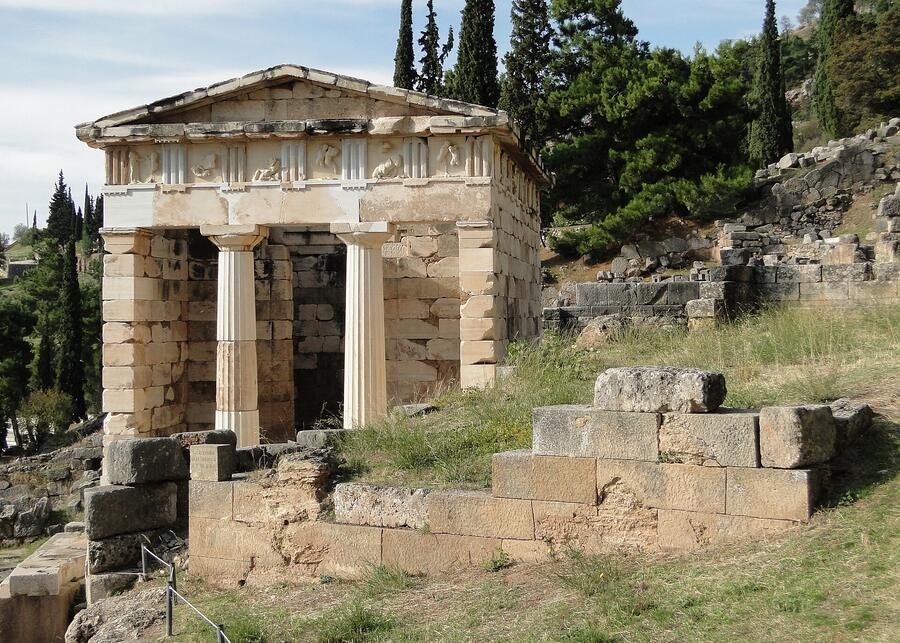
Athenian Treasury
This small Doric building in marble is the only treasury rebuilt in full, put back together by French archaeologists in the early 20th century. The ancient writer Pausanias says Athens paid for it from the spoils of Marathon in 490 BC. Some scholars date it earlier. Look closely at the walls: they are covered in inscribed decrees, and hymns to Apollo with musical notation were carved here.
03
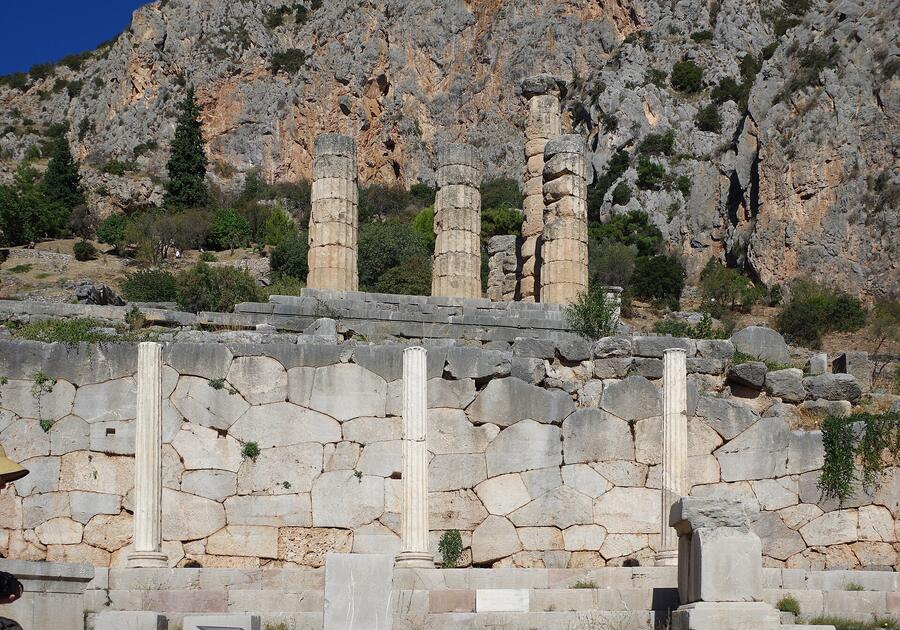
Polygonal Wall and Stoa of the Athenians
The wall holding up the temple terrace is built of many-sided blocks fitted together without mortar. Its face carries hundreds of inscriptions, most of them records of slaves being freed. In front stands the Stoa of the Athenians, whose inscribed step says it held arms and ship ornaments taken from enemies.
04
Temple of Apollo
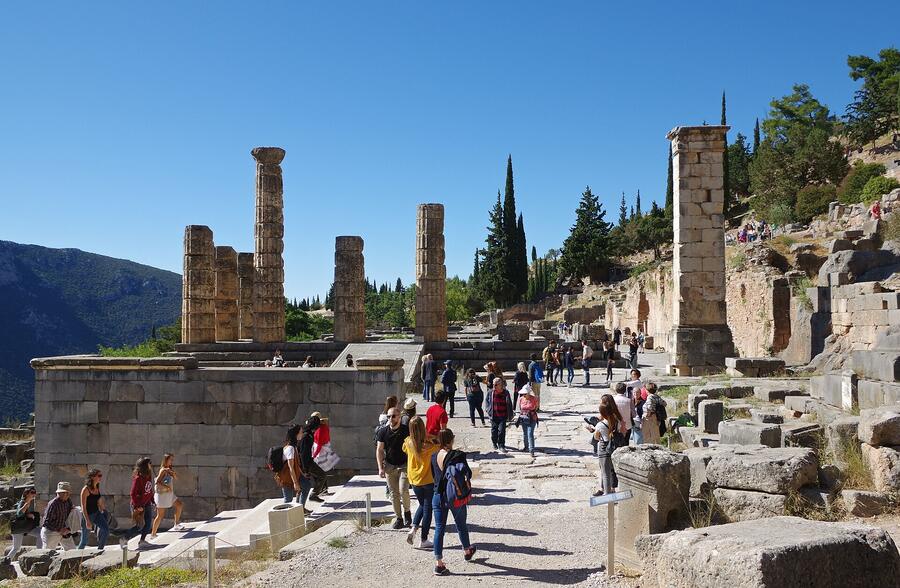
The foundations and a few re-erected Doric columns belong to the 4th-century BC temple built after the earthquake of 373 BC. The Pythia gave her answers in an inner room called the adyton. Many visitors walk past the great altar in front of the temple: the island of Chios gave it, and it was partly rebuilt in the 20th century.
Tip The temple is fenced off. The best view of it is from the theatre above.
05
Theatre
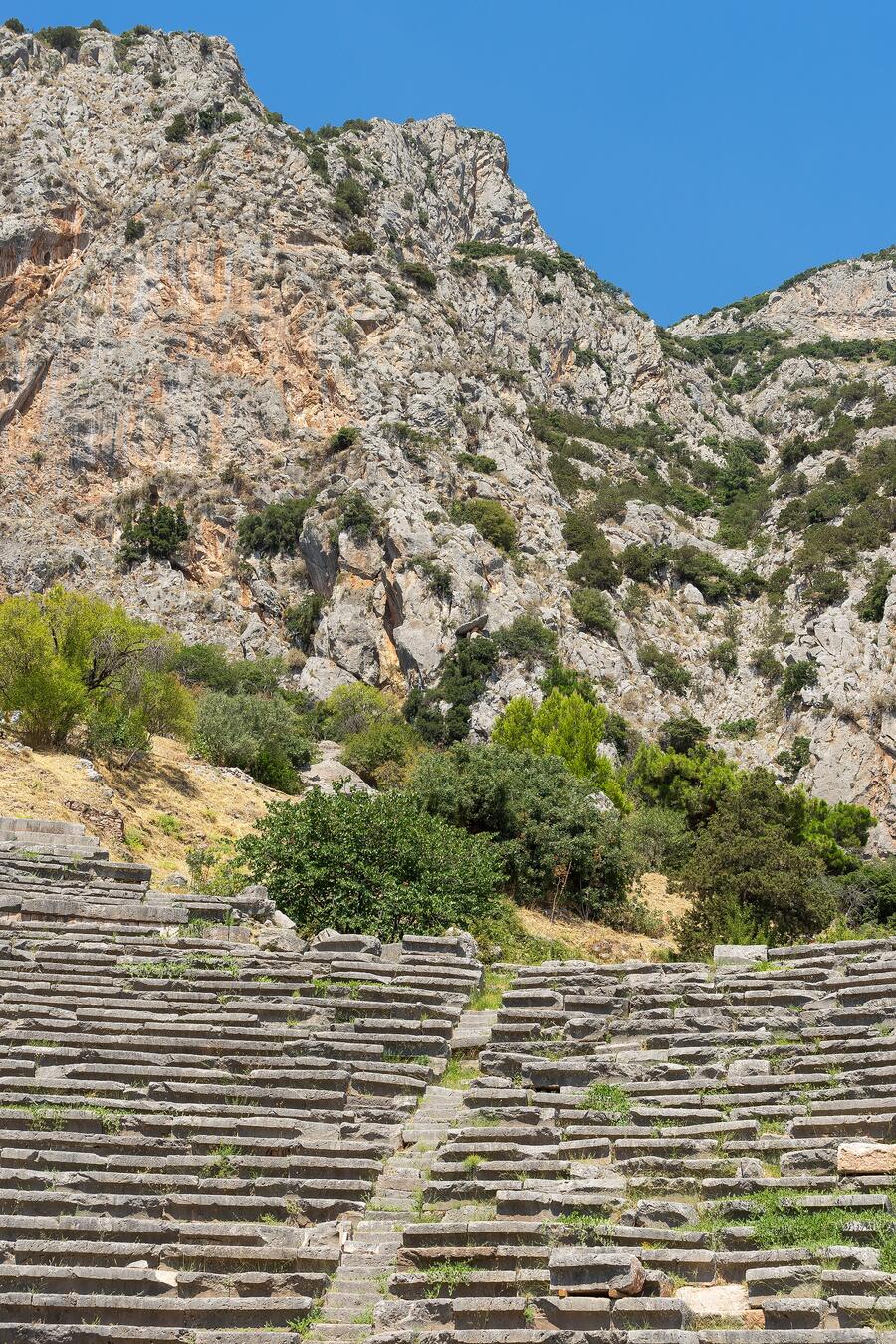
The theatre was built in the 4th century BC and rebuilt several times, notably under the Romans. It seated about 5,000 people, and it held the musical contests of the Pythian Games. From the top rows the whole sanctuary and the Pleistos valley lie below you.
Tip Climb to the path above the top row for the classic view over the temple to the valley.
06
Stadium
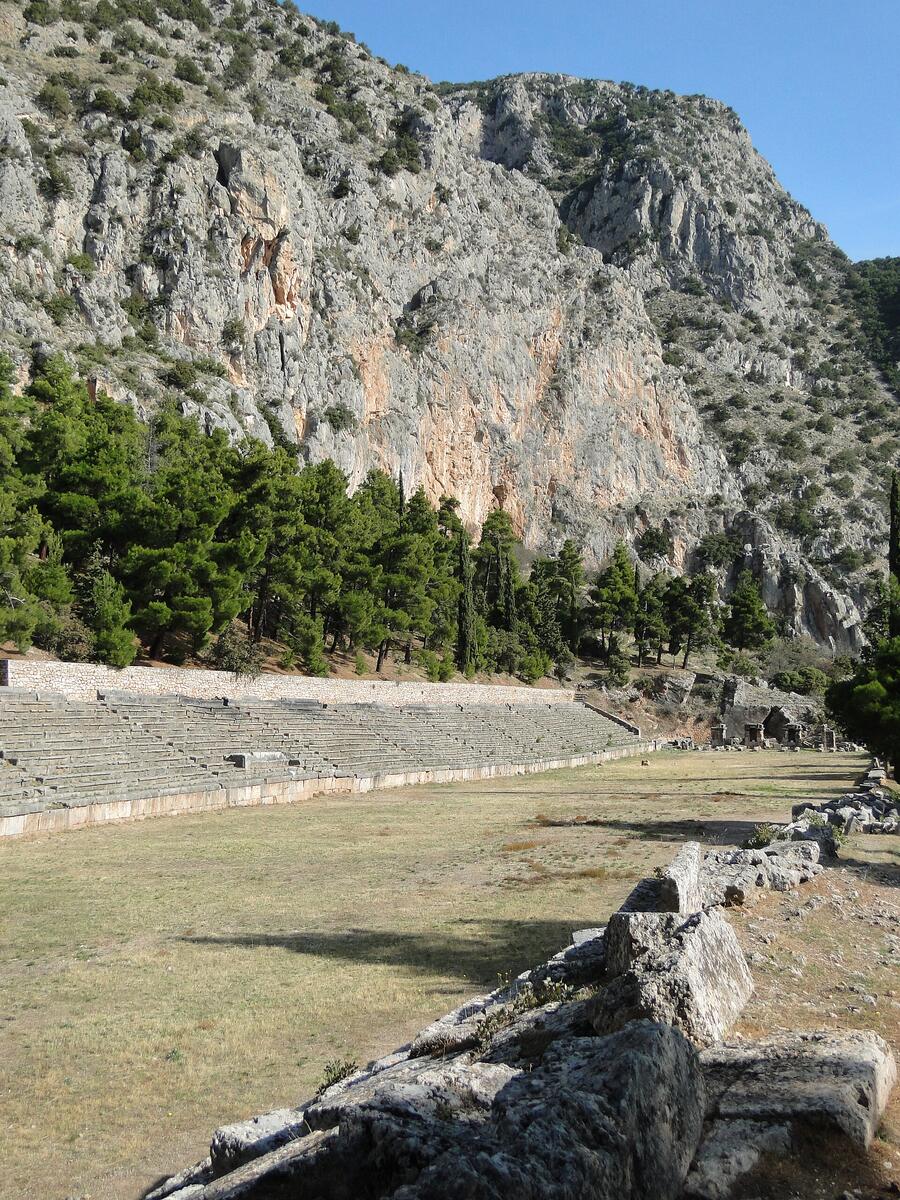
The stadium is the highest point of the sanctuary, with a track about 178 m long. Its stone seats were added in the 2nd century AD, paid for by the Athenian benefactor Herodes Atticus. At each end lie the stone starting lines, with grooves where runners set their toes.
Tip This is the steepest stretch and has little shade. Go early, and carry water.
The museum
Delphi Archaeological Museum
Delphi
The star is the bronze Charioteer of Delphi, part of a group dedicated around 470 BC. Also look for the Naxian Sphinx, the twin statues known as Kleobis and Biton, the Siphnian Treasury frieze and the omphalos stone.
Nearby
- Hosios Loukas An 11th-century Byzantine monastery with gold-ground mosaics, also a UNESCO World Heritage Site.
- Chaeronea The battlefield where Philip II of Macedon defeated Athens and Thebes in 338 BC, marked by a marble lion.
- Orchomenos A Mycenaean tholos tomb, the Treasury of Minyas, with a carved stone ceiling in its side chamber.
Before you go
- Wear shoes with a good grip. The paths are steep and the marble paving is polished smooth.
- Climb the sanctuary early while it is cool, and save the museum for the hottest part of the day.
- Bring water and a hat. The upper slopes have little shade.
- Do not skip the Sanctuary of Athena Pronaia, a short walk east along the road past the Castalian Spring. Its round Tholos, from about 380 BC, has three re-erected columns, and its purpose is still unknown.
News from Delphi and the rest of the ancient world, every day: ancientherald.com
Photos
- Marmaria, the lower sanctuary of Delphi, northwestern part: Zde, CC BY-SA 4.0 (source)
- The Sacred Way in the Sanctuary of Apollo: George E. Koronaios, CC BY-SA 4.0 (source)
- Treasury of the Athenians: Bernard Gagnon, CC BY-SA 4.0 (source)
- Polygonal wall below the Temple of Apollo: Berthold Werner, CC BY-SA 3.0 (source)
- Temple of Apollo: Berthold Werner, CC BY-SA 3.0 (source)
- Ancient theatre with mountains behind: Jebulon, CC0 (source)
- Stadium of Delphi: Bernard Gagnon, CC BY-SA 4.0 (source)


Ancient Herald · Explore Yourself
Facts checked against standard references. Opening times and tickets change: check them locally before you go.