Ephesus: a pocket guide
Walk a Roman marble street downhill to the Library of Celsus and a theatre cut into the hillside.
Download the pocket guide PDF for your phone · 1.5 MB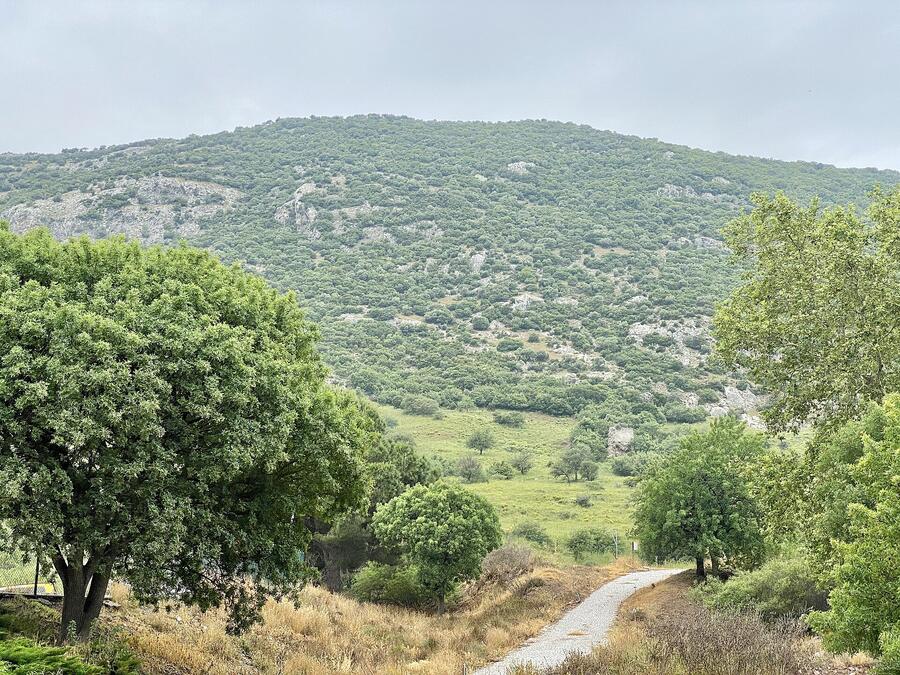
Explore Yourself · No. 06
Ephesus
Walk a Roman marble street downhill to the Library of Celsus and a theatre cut into the hillside.
Ancient Herald pocket guide
At a glance
- Where
- Aegean coast, İzmir Province, Turkey; about 3 km from Selçuk
- Period
- c. 600 BC–AD 600; at its peak in the 1st–2nd centuries AD
- Time to allow
- 3–4 hours for the site and the Terrace Houses; a full day with the museum and the Temple of Artemis.
- Best time
- Spring (April–May) or autumn (September–October). Come early or in the late afternoon: the site has little shade, the marble throws back the heat, and tour groups peak at midday. Morning light falls on the east-facing library.
The story
Ephesus was one of the great cities of the Greek and Roman world. Ionian Greeks founded it as a port on the Aegean coast. Its Temple of Artemis was one of the Seven Wonders of the ancient world. Under Rome it was the chief city of the province of Asia.
Few ancient cities let you walk such long stretches of their streets. A marble road runs downhill past temples, fountains and houses to the Library of Celsus and a theatre for more than 20,000 people. Ephesus also matters for early Christianity. Paul preached here, and a church council met here in AD 431. The harbour later silted up and the city faded. Austrian archaeologists have excavated here since 1895, and UNESCO listed the site in 2015.
Through time
- c. 10th century BCIonian Greek settlers establish Ephesus on the Aegean coast.
- c. 560 BCKing Croesus of Lydia takes the city and helps pay for a vast marble Temple of Artemis.
- 356 BCA man named Herostratus sets fire to the temple, and the Ephesians rebuild it on the same scale.
- Early 3rd century BCLysimachus, one of Alexander's generals, moves the city to its present site between two hills.
- 1st–2nd centuries ADAs the chief city of Rome's province of Asia, Ephesus gains its library, terrace houses and enlarged theatre, and Paul preaches here.
- AD 431The Council of Ephesus meets in the city's Church of Mary.
01
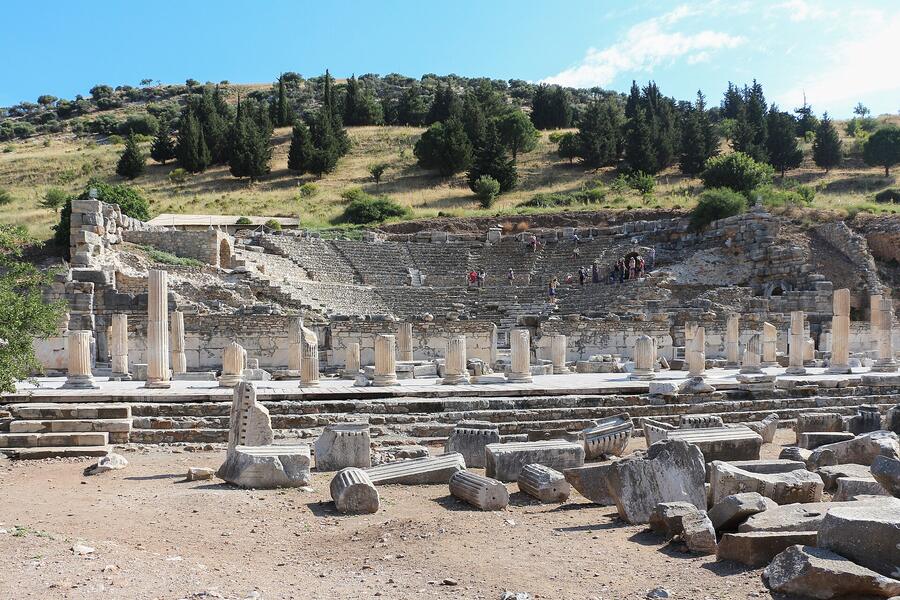
Upper Agora and Odeon
The Upper (State) Agora was the civic square, lined by a long colonnade. Beside it is the Odeon, a small theatre for council meetings and music that once had a wooden roof. Most people miss the Prytaneion behind it, where the sacred flame was kept and the two famous Artemis statues were found.
Tip Start at the upper gate here so the whole walk runs downhill.
02
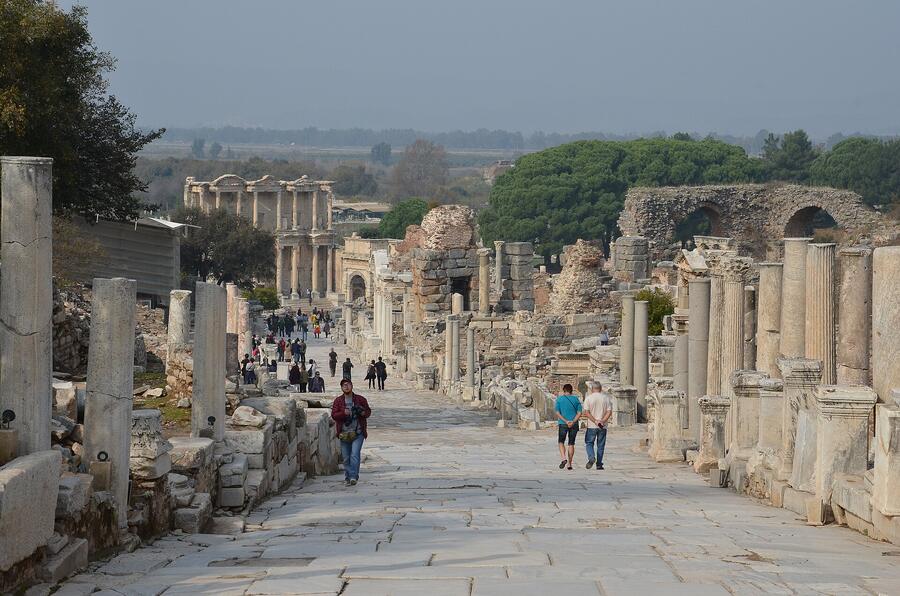
Curetes Street
This marble street drops from the Gate of Hercules to the library, past fountains, statue bases and shop fronts. The gate's pillars show Hercules wearing his lion skin. Many walk past the relief of Nike, a winged Victory holding a wreath, near the top of the street.
Tip The paving is uneven and polished, so stop before you look up at the facades.
03
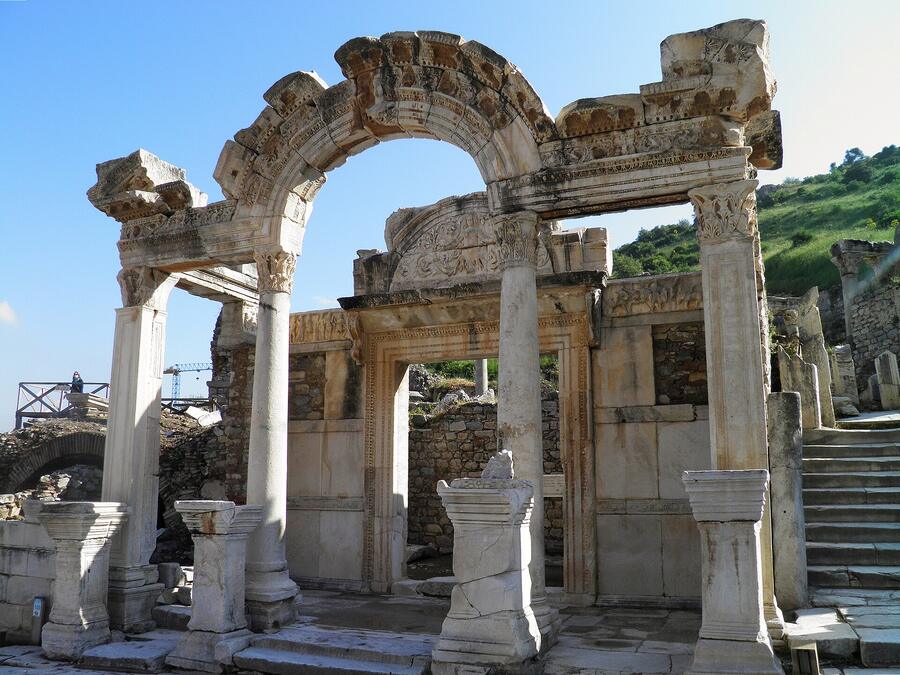
Temple of Hadrian
This small 2nd-century AD temple honoured the emperor Hadrian. The front arch has a bust of Tyche, goddess of fortune, and the inner arch a head of Medusa. The frieze above the inner door is a copy; the originals are in the Ephesus Museum in Selçuk.
Tip The public latrines are close by: rows of marble seats over a channel of running water.
04
Terrace Houses
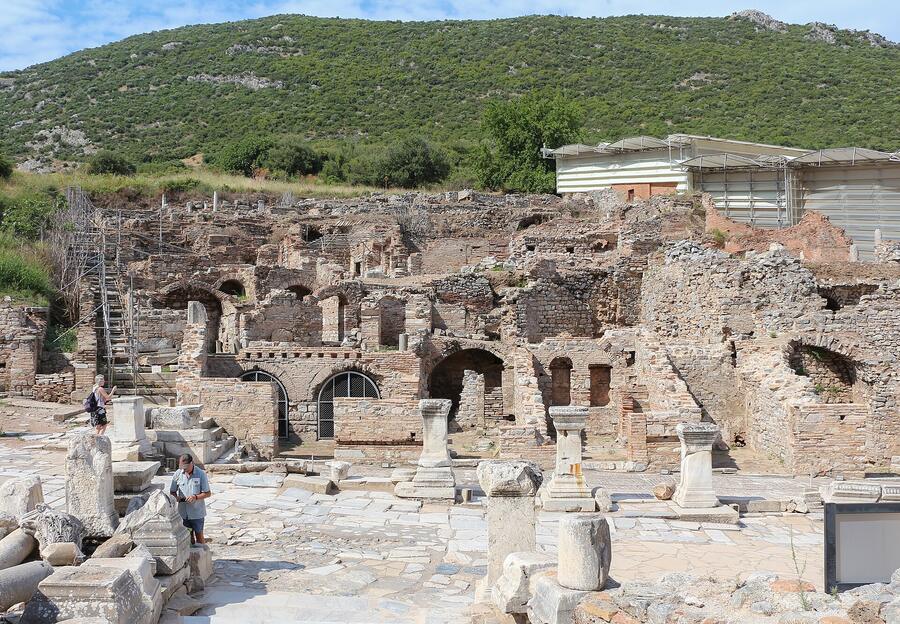
These were the homes of wealthy Roman families, built on the slope opposite the Temple of Hadrian. Walkways lead over rooms with wall paintings, mosaic floors and marble wall panels. Look closely at the plaster for graffiti scratched by the people who lived here.
Tip The houses sit under a modern roof, so they make a shaded break in the midday heat.
05
Library of Celsus
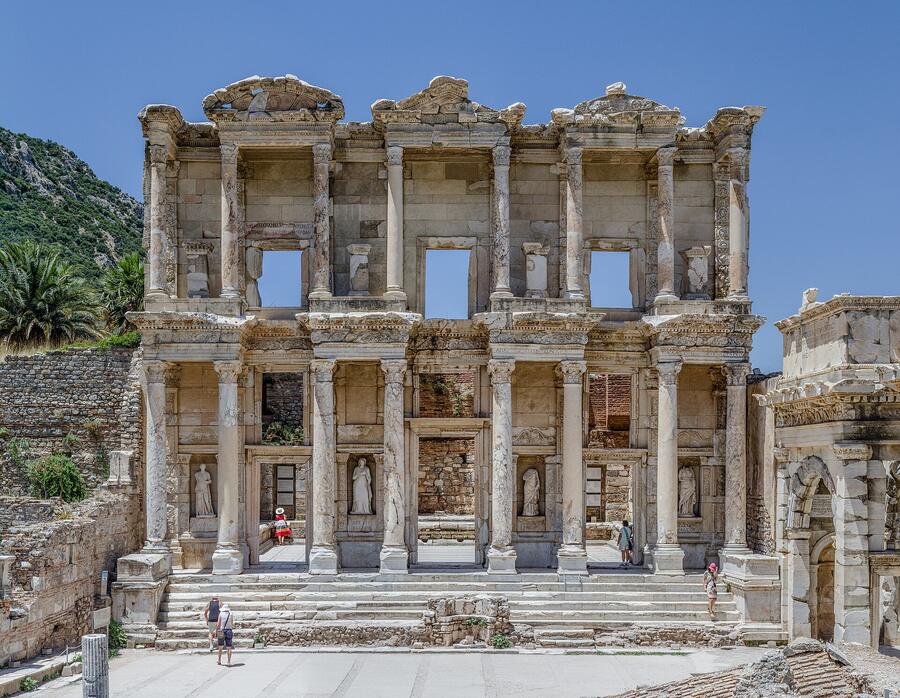
A son built this library in the early 2nd century AD to honour his father, Tiberius Julius Celsus Polemaeanus, a governor of Asia. Celsus was buried in a chamber beneath it. The four women in the niches are virtues such as Wisdom and Knowledge; they are copies, and the originals are in Vienna.
Tip Austrian archaeologists re-erected the facade in the 1970s. Beside it is the gate of Mazeus and Mithridates, two freed slaves who built it in honour of Augustus.
06
Great Theatre
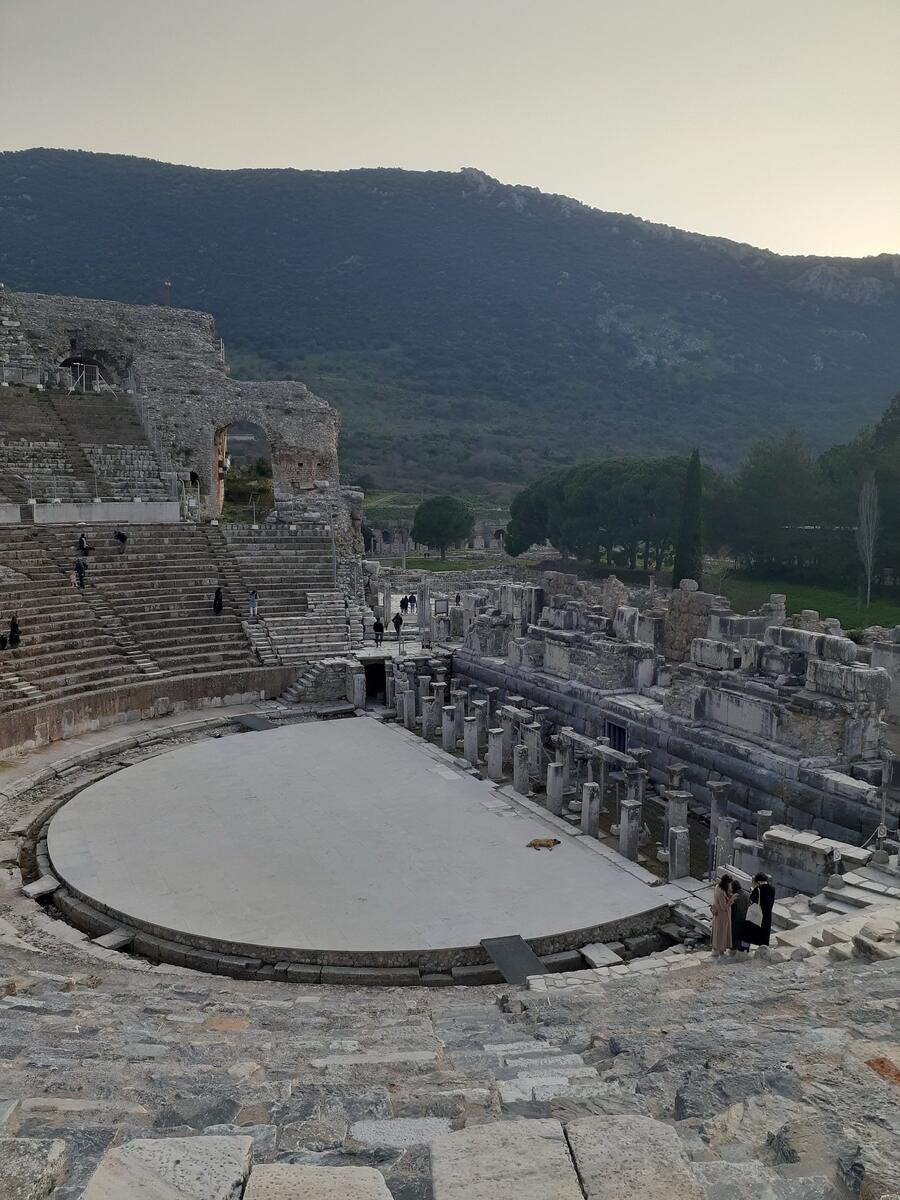
Cut into Panayır Hill, the theatre held more than 20,000 people. The Acts of the Apostles places the silversmiths' riot against Paul here, when the crowd shouted 'Great is Artemis of the Ephesians'. From the top rows, follow the Arcadian Way west to the old harbour, now silted up and kilometres from the sea.
Tip Climb to the upper rows for the best view over the lower city.
The museum
Ephesus Museum
Selçuk
Two marble statues of Artemis of Ephesus, known as the Great Artemis and the Beautiful Artemis, show the goddess with rows of rounded ornaments across her chest. The museum also holds the original friezes from the Temple of Hadrian and a fresco of Socrates from the Terrace Houses.
Nearby
- Temple of Artemis, Selçuk A single column rebuilt from fragments marks the site of one of the Seven Wonders, in a marshy field.
- Basilica of St John, Selçuk Ruins of a large 6th-century church built under Justinian over the traditional tomb of John the Apostle, on Ayasuluk Hill.
- Priene A small Hellenistic town on a grid of streets below a cliff, with the columns of its Temple of Athena.
Before you go
- Wear shoes with good grip: the marble paving is worn smooth and slippery, especially after rain.
- Carry water and a hat. There is little shade, and the stone reflects the heat.
- Enter at the upper gate and walk downhill to the lower gate by the theatre. Plan your ride back to the start before you set off.
- For the classic view, look down Curetes Street to the library from the top of the slope, then climb the theatre for the Arcadian Way.
News from Ephesus and the rest of the ancient world, every day: ancientherald.com
Photos
- Ephesus archaeological site with mountains beyond: Warren LeMay from Chicago, IL, United States, CC BY-SA 2.0 (source)
- The Odeon (bouleuterion) seating: Bernard Gagnon, CC BY-SA 3.0 (source)
- Looking down Curetes Street: shankar s. from Dubai, united arab emirates, CC BY 2.0 (source)
- Temple of Hadrian facade: Carole Raddato from FRANKFURT, Germany, CC BY-SA 2.0 (source)
- Terrace Houses: Bernard Gagnon, CC BY-SA 3.0 (source)
- Façade of the Library of Celsus: Benh LIEU SONG, CC BY-SA 3.0 (source)
- Great Theatre from the upper seats toward the Harbour Street: Furkan Akkurt, CC BY-SA 4.0 (source)


Ancient Herald · Explore Yourself
Facts checked against standard references. Opening times and tickets change: check them locally before you go.