The Pyramids of Giza: a pocket guide
The last of the Seven Wonders still standing, with the Sphinx at its feet and Cairo at its edge.
Download the pocket guide PDF for your phone · 1.1 MB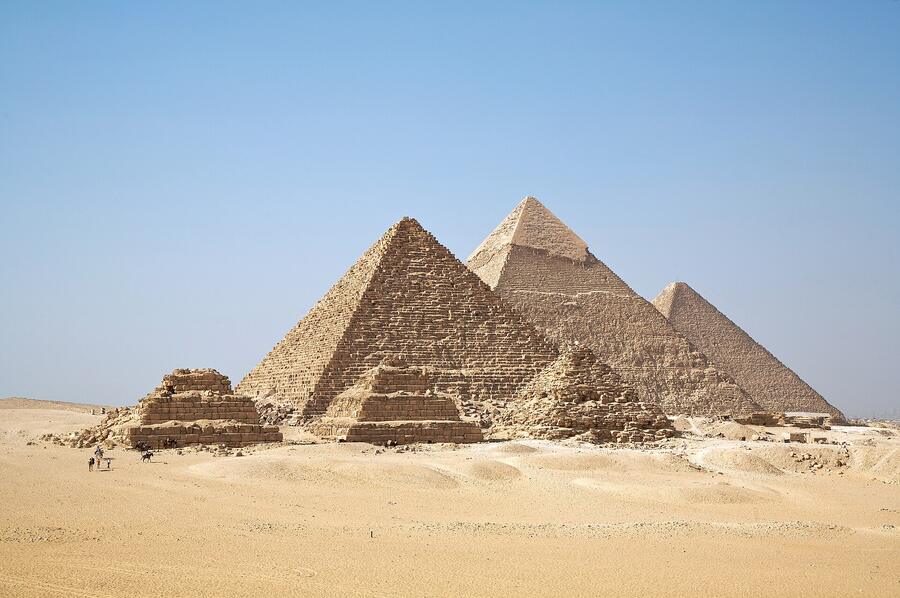
Explore Yourself · No. 08
The Pyramids of Giza
The last of the Seven Wonders still standing, with the Sphinx at its feet and Cairo at its edge.
Ancient Herald pocket guide
At a glance
- Where
- Giza plateau, west bank of the Nile, Egypt; nearest town Giza, on the western edge of Cairo
- Period
- c. 2600–2500 BC (Fourth Dynasty)
- Time to allow
- Half a day for the outside of all three pyramids, the viewpoint and the Sphinx. Allow a full day if you go inside a pyramid and add a museum.
- Best time
- October to March, when the heat is bearable. Arrive at opening: the air is cooler, the coach groups have not arrived, and the low sun brings out the texture of the stone.
The story
The Pyramids of Giza are the tombs of three kings of Egypt's Fourth Dynasty: Khufu, his son Khafre and Khafre's son Menkaure. They were built in the 26th century BC on a limestone plateau on the west bank of the Nile. Each pyramid had temples, a causeway and smaller pyramids for queens. Stone tombs of officials and royal relatives fill the ground around them.
The Great Pyramid of Khufu was the tallest structure built by humans for more than 3,800 years. It is the only one of the Seven Wonders of the ancient world still standing. The Great Sphinx, carved from the bedrock, guards the route up from the valley. Excavations south of the plateau found the town and cemetery of the builders. The finds suggest a large, organised workforce that the state fed and housed.
Through time
- Early 26th century BCKhufu's builders raise the Great Pyramid, the first and largest pyramid at Giza.
- Mid-26th century BCKhafre builds the second pyramid, and most Egyptologists date the carving of the Sphinx to his reign.
- Late 26th century BCMenkaure builds the third and smallest of the main pyramids.
- c. 1400 BCThutmose IV sets up the Dream Stele between the paws of the Sphinx after clearing the sand around it.
- 5th century BCThe Greek historian Herodotus visits Egypt and writes an account of the pyramids and their builders.
- AD 1979UNESCO lists Giza as part of the World Heritage Site of Memphis and its Necropolis.
01
Great Pyramid of Khufu
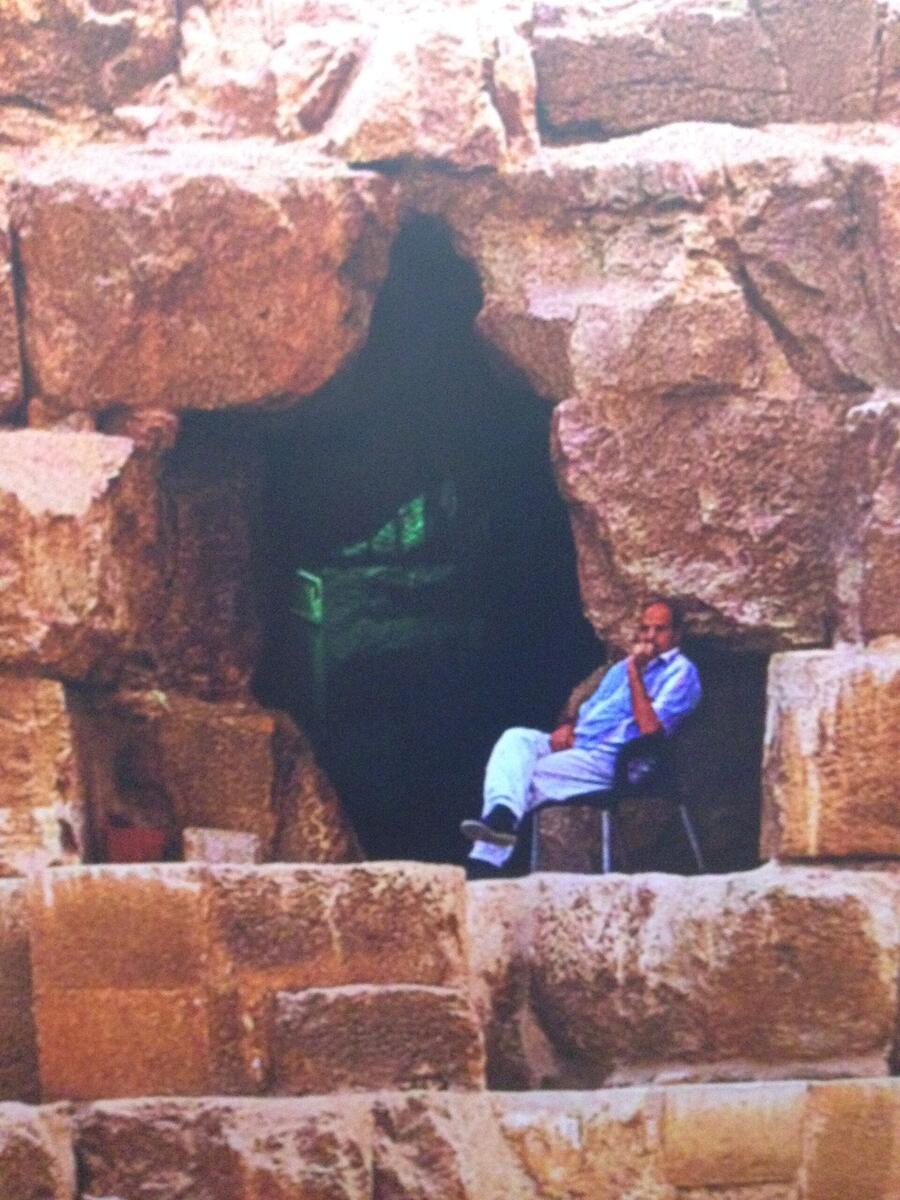
Built for Khufu, it rose about 146 m and now stands about 139 m after losing its smooth limestone casing. Visitors go in through a tunnel traditionally credited to Caliph al-Ma'mun in the 9th century AD. Look higher up the north face for the original entrance, capped by huge paired limestone blocks set like a roof.
Tip The route to the King's Chamber climbs steeply, bent double in a low passage before the tall Grand Gallery. Go in early, before the air inside turns hot and stale.
02
Pyramid of Khafre
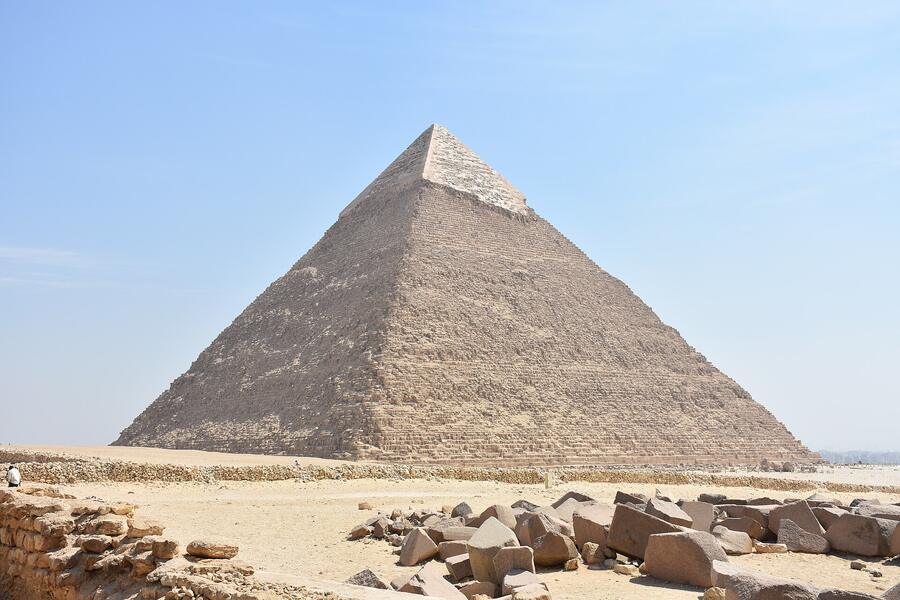
Khafre's pyramid looks taller than his father's because it stands on higher bedrock, but it was slightly lower, at about 143.5 m. Near the summit a cap of the original smooth casing survives. It shows how all three pyramids once looked.
Tip The ruined mortuary temple on its east side is the top of the causeway that runs down to the Sphinx.
03
Pyramid of Menkaure
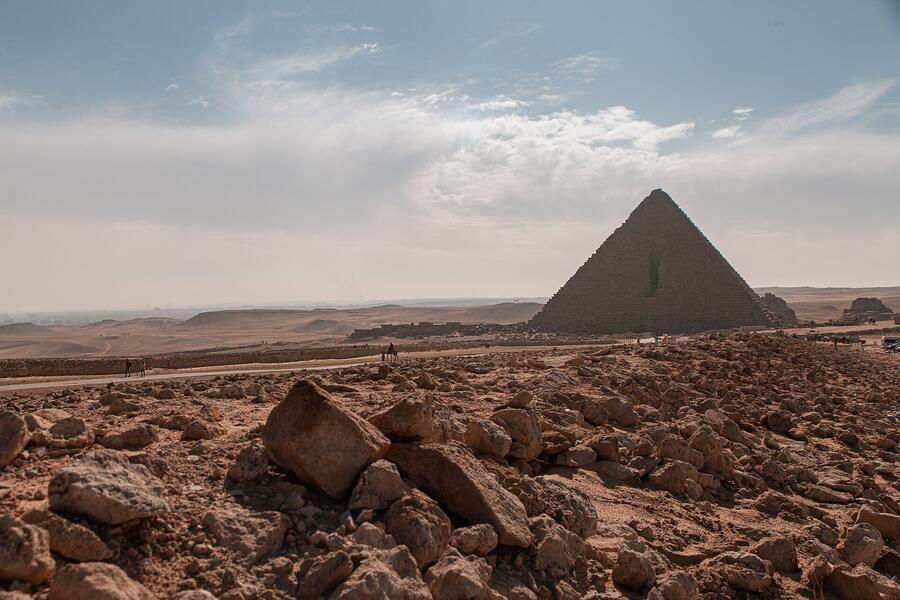
The smallest of the three was originally about 65 m high. Its lowest courses were cased in red granite brought from Aswan, and on part of the face the blocks were never smoothed. The deep gash in the north face comes from a failed attempt to demolish the pyramid in AD 1196.
Tip Three small queens' pyramids stand on its south side, on the way to the viewpoint.
04
Panorama viewpoint
This rise in the desert south-west of the pyramids is where all three line up in a single view. From here the gap in size between Menkaure's pyramid and the other two is plain. Look closely and you can pick out the small queens' pyramids beside Menkaure's.
Tip In late afternoon the sun is behind you and lights the faces you are looking at.
05
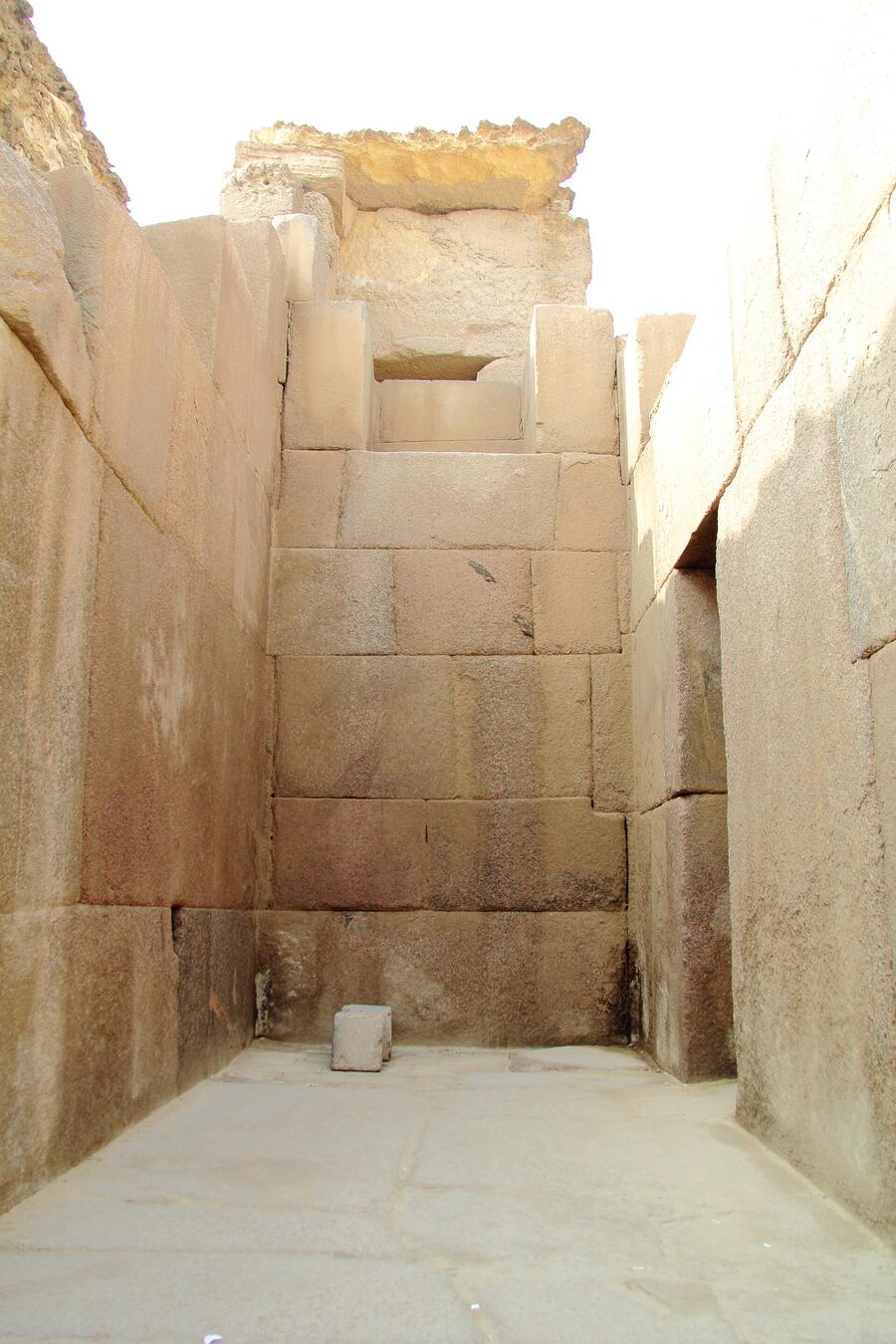
Valley Temple of Khafre
This temple at the foot of Khafre's causeway was built of massive limestone blocks faced with red granite. Square granite pillars stand in a T-shaped hall with a floor of white calcite. In 1860 Auguste Mariette found the seated diorite statue of Khafre here, buried in a pit.
Tip A walkway leads from the temple to the terrace beside the Sphinx.
06
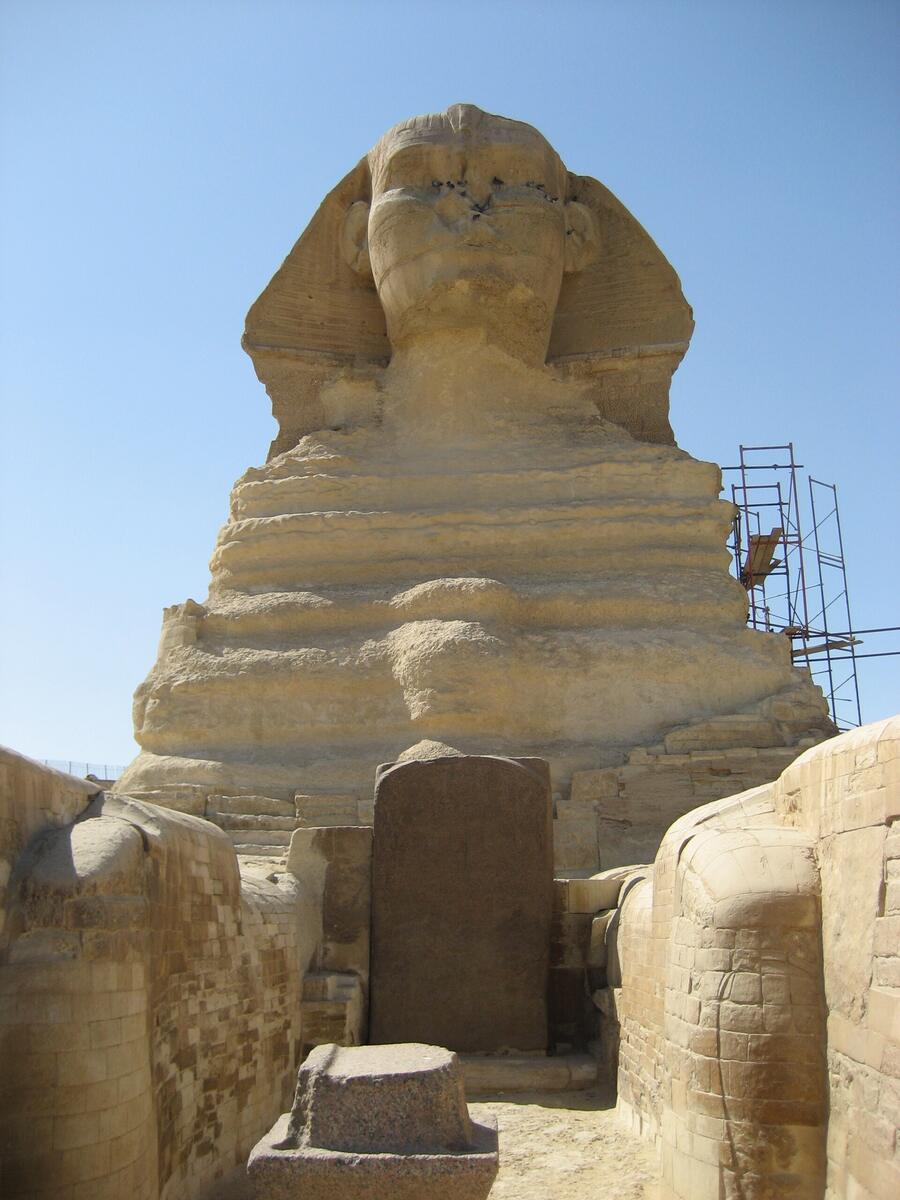
Great Sphinx
The Sphinx was carved from the bedrock: a lion's body with a king's head, about 73 m long and 20 m high. Most Egyptologists think the face is Khafre's. Between its paws stands the Dream Stele of Thutmose IV, which tells how the Sphinx promised him the throne if he cleared away the sand that buried it.
Tip The terrace is most crowded in the middle of the day and thins out later.
The museum
Egyptian Museum
Cairo
The diorite statue of Khafre, enthroned with the falcon god Horus behind his head, came from his Valley Temple at Giza. Nearby stand the greywacke triads of Menkaure with the goddess Hathor, found in his valley temple.
Nearby
- Saqqara The Step Pyramid of Djoser, built about a century before Giza, is the earliest large stone building in Egypt.
- Dahshur The Bent Pyramid and the Red Pyramid of Sneferu, Khufu's father, show how pyramid builders learned their craft.
- Memphis (Mit Rahina) The ruins of Egypt's old capital, with a colossal fallen statue of Ramesses II and a large calcite sphinx.
Before you go
- Wear closed shoes with good grip for the sand, loose stone and steep passages inside the pyramids.
- There is almost no shade on the plateau. Bring a hat, sunscreen and more water than you think you need.
- The pyramid interiors are hot, humid and cramped. Skip them if you dislike tight spaces.
- Camel, horse and guide offers are frequent. Agree the price and the route before you set off, or decline firmly.
News from The Pyramids of Giza and the rest of the ancient world, every day: ancientherald.com
Photos
- All three Giza pyramids in one view: Ricardo Liberato, CC BY-SA 2.0 (source)
- Entrance on the north face of the Great Pyramid: PBA team, CC BY-SA 4.0 (source)
- Pyramid of Khafre in 2015: MusikAnimal, CC BY-SA 3.0 (source)
- Pyramid of Menkaure with remains of granite casing: Mohamedibrahem2025, CC BY-SA 4.0 (source)
- Valley Temple of Khafre, 2019: Djehouty, CC BY-SA 4.0 (source)
- Great Sphinx with the Dream Stele between its paws: Chanel Wheeler, CC BY-SA 2.0 (source)


Ancient Herald · Explore Yourself
Facts checked against standard references. Opening times and tickets change: check them locally before you go.