Knossos: a pocket guide
Walk the corridors of the Minoan palace that Greek myth turned into the Labyrinth of the Minotaur.
Download the pocket guide PDF for your phone · 1.2 MB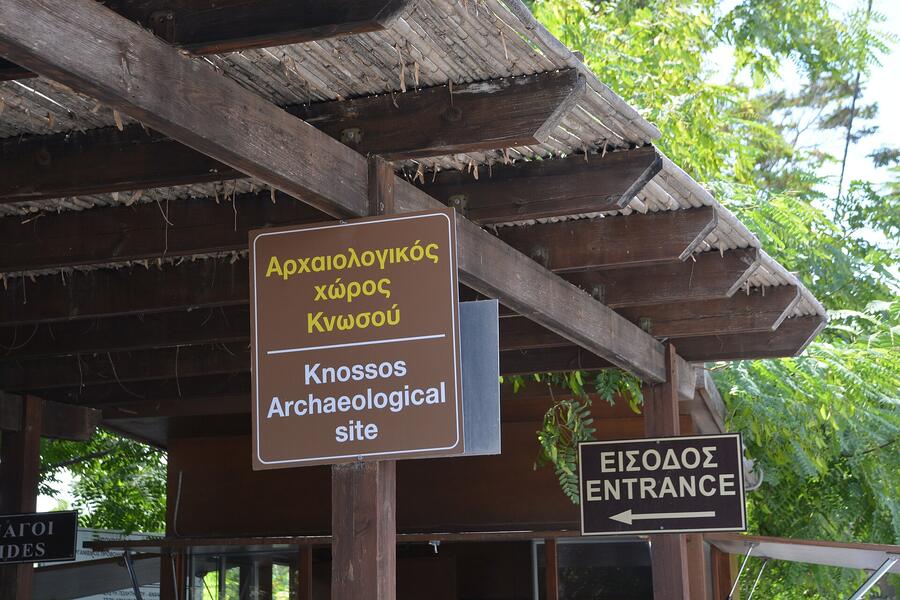
Explore Yourself · No. 03
Knossos
Walk the corridors of the Minoan palace that Greek myth turned into the Labyrinth of the Minotaur.
Ancient Herald pocket guide
At a glance
- Where
- Crete, Greece; about 5 km south-east of central Heraklion
- Period
- c. 1900–1350 BC (Minoan palace); settled from around 7000 BC
- Time to allow
- 2 to 3 hours on site, plus 2 to 3 hours for the museum in Heraklion
- Best time
- Spring (April to early June) or autumn (September and October). Arrive at opening time or in the late afternoon. Summer middays are hot and shade is scarce, and tour groups peak in mid-morning. Low sun also warms the colour of the stone and the red columns.
The story
Knossos was the largest palace of Bronze Age Crete and the centre of the Minoan civilisation. Its rooms, corridors, storerooms and courts covered a low hill south of Heraklion. People lived here from around 7000 BC, and the first palace rose around 1900 BC. Huge storage jars held its oil, grain and wine. Greek myth placed King Minos and the Labyrinth of the Minotaur here.
Arthur Evans excavated the site from 1900 and named the Minoans after Minos. He rebuilt parts of the palace in concrete and had frescoes repainted, so some of what you see is his interpretation. Evans also found thousands of clay tablets. Those in Linear B were deciphered by Michael Ventris in 1952 as an early form of Greek. The older Linear A script is still unread.
Through time
- Around 7000 BCNeolithic farmers settle the hill, starting one of the longest-lived settlements in Crete.
- Around 1900 BCThe first palace is built around a large central court.
- Around 1700 BCThe palace is destroyed, probably by an earthquake, and rebuilt on a grander scale.
- Around 1450 BCMany Cretan palaces are destroyed, but Knossos survives and its rulers keep records in Linear B Greek.
- 14th century BCFire destroys the palace; the exact date is debated.
- AD 1900Arthur Evans begins excavating and later reconstructs parts of the palace in concrete.
01
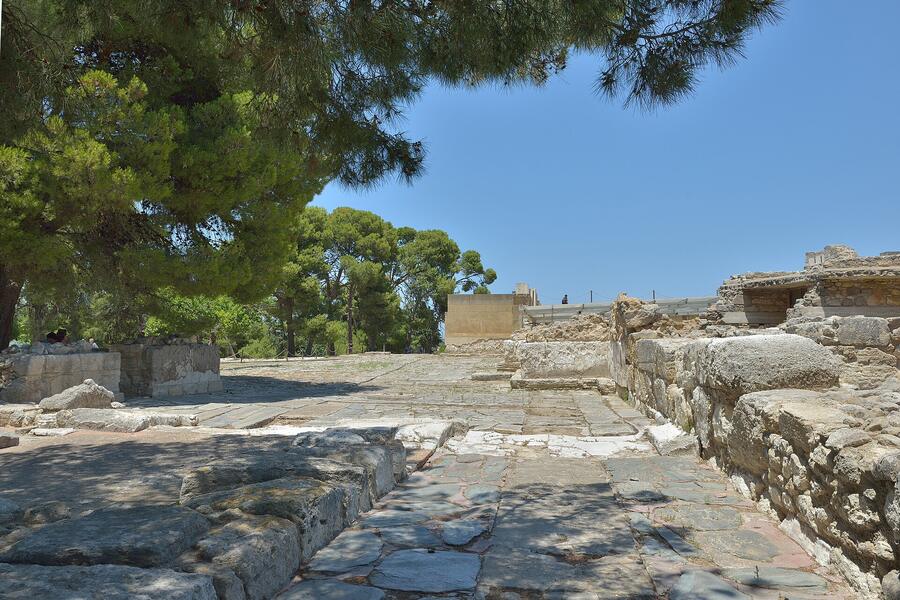
West Court
This paved court lies in front of the palace's west facade. Look for three large round stone-lined pits, called kouloures, which may have stored grain or held rubbish. Most people miss the slightly raised paved walkways that cross the court.
Tip A bronze bust of Arthur Evans stands near the start of the path.
02
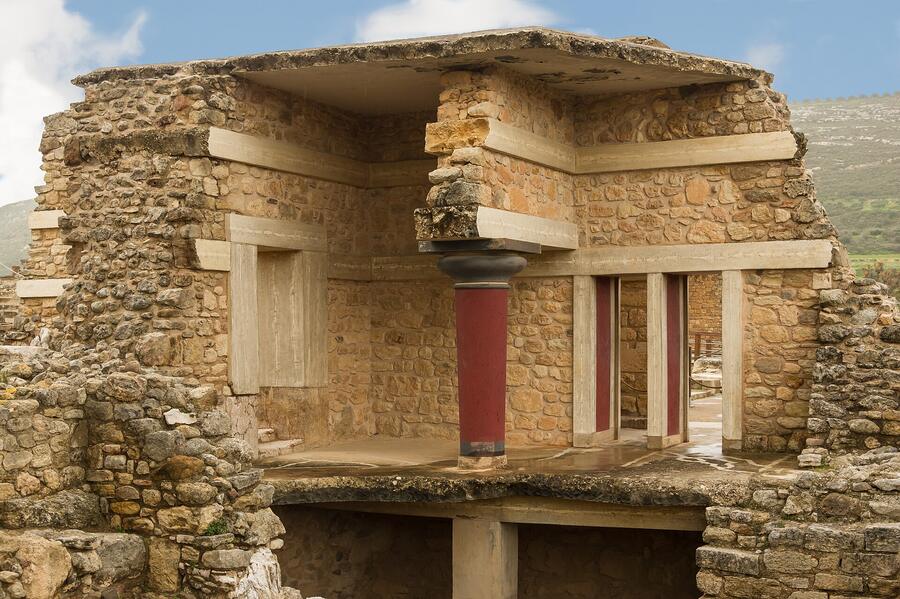
South Propylaeum and Piano Nobile
The South Propylaeum is a grand entrance where Evans set up copies of the Procession Fresco, including the Cup-Bearer. Stairs lead to the Piano Nobile, an upper floor he rebuilt. From its edge, look down on the West Magazines: long, narrow storerooms with tall clay jars and stone-lined pits sunk into the floors.
Tip The upper floor is Evans's concrete. The walls and storerooms below are Minoan.
03
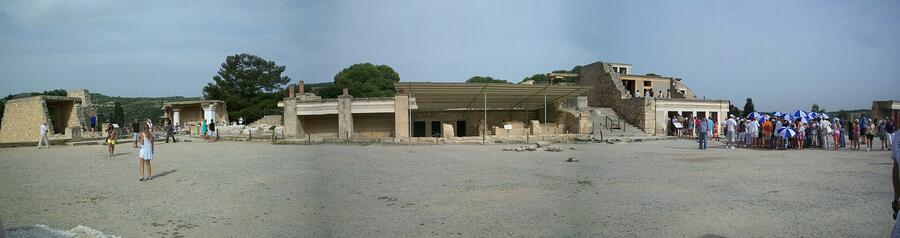
Central Court
This long open court, about 50 m long, was the heart of the palace, with its wings arranged around it. It runs roughly north to south. Many visitors miss the view south to Mount Juktas, which had a Minoan sanctuary on its summit.
Tip There is almost no shade here, so keep this stop short at midday.
04
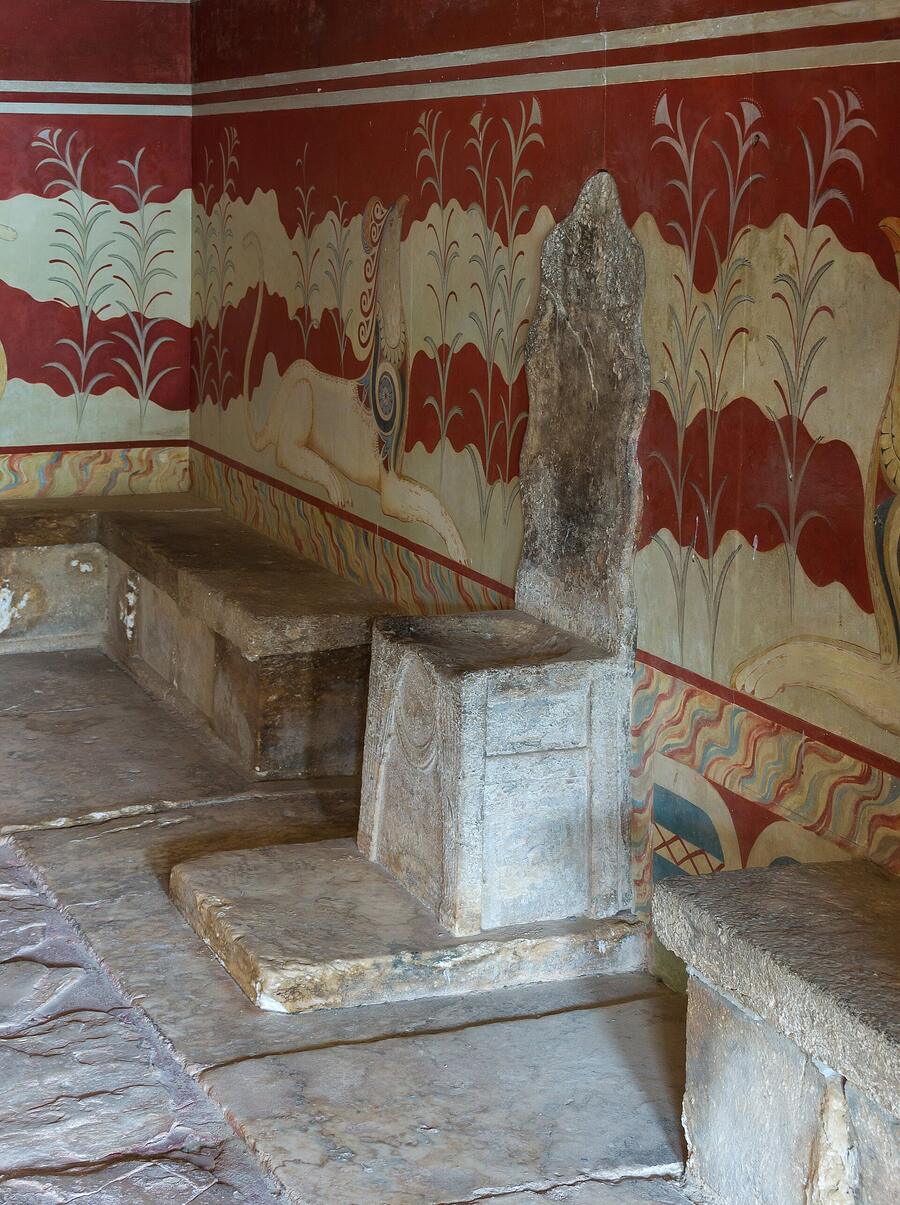
Throne Room
A stone throne stands against the wall, flanked by stone benches and painted griffins. The throne is original and was found in place; the griffin frescoes are restored. Opposite it, steps lead down into a sunken area Evans called a lustral basin, whose purpose is still debated.
Tip The doorway gets crowded. Come early or late for a clear look.
05
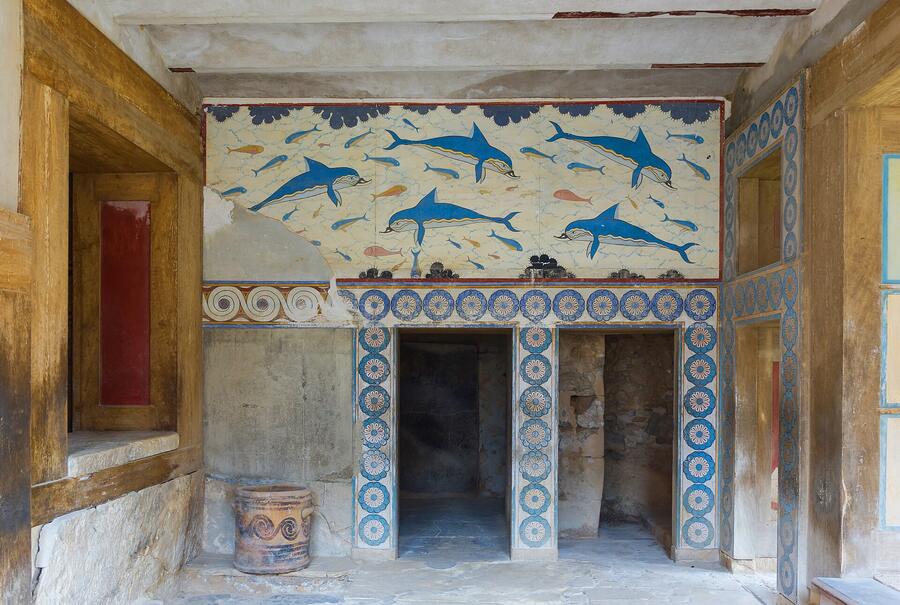
Grand Staircase and Queen's Megaron
The Grand Staircase descended several storeys into the east wing, lit by a light well. Below lie the rooms Evans called the royal apartments, including the Hall of the Double Axes and the Queen's Megaron with its copy of the dolphin fresco. Most people miss the drainage: stone channels and clay pipes carried water through the palace.
06
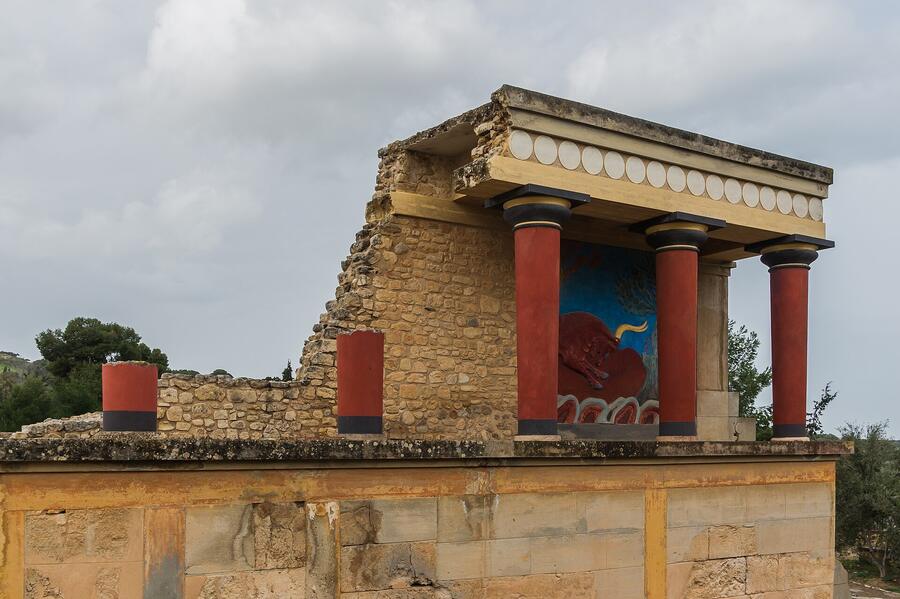
North Entrance and Royal Road
A ramped passage leads north out of the palace, beside a portico with a copy of a relief fresco of a charging bull. Beyond it lie the North Pillar Hall, the Theatral Area and the paved Royal Road. Many people skip the Theatral Area, low steps where people may have stood to watch ceremonies.
Tip The bull relief is the busiest photo spot. If it is crowded, come back at the end.
The museum
Heraklion Archaeological Museum
Heraklion
From Knossos come the faience Snake Goddess figurines, the black stone bull's-head rhyton and the original Bull-Leaping, Prince of the Lilies and Cup-Bearer frescoes. The museum also holds Linear A and Linear B tablets and, from Phaistos, the Phaistos Disc.
Nearby
- Phaistos The second great Minoan palace, on a ridge above the Mesara plain in southern Crete, where the Phaistos Disc was found.
- Malia A Minoan palace on the north coast east of Heraklion, much less rebuilt than Knossos.
- Gortyn A Greek and Roman city near Phaistos, known for the Gortyn law code carved in stone.
Before you go
- Wear shoes with good grip. The paths are uneven and the worn stone and gypsum can be slippery.
- Shade is scarce. Bring a hat and water, especially from late spring to early autumn.
- Visit the Heraklion Archaeological Museum as well. The frescoes on site are copies, and the originals are there.
- For the best overview, stand on Evans's rebuilt upper floor above the West Magazines.
News from Knossos and the rest of the ancient world, every day: ancientherald.com
Photos
- Knossos archaeological site: Jonashtand, CC BY-SA 4.0 (source)
- The West Court at Knossos: This Photo was taken by Wolfgang Moroder . Feel free to use my photos, but please mention me as the author and send me a, CC BY-SA 3.0 (source)
- South Propylaeum of Knossos palace: Jebulon, CC0 (source)
- Panoramic view of the Central Court: C messier, CC BY-SA 3.0 (source)
- Throne of Minos in the Throne Room: Jebulon, CC0 (source)
- Queen's Megaron with dolphin fresco copy: Jebulon, CC0 (source)
- North Entrance with Bull Fresco reproduction: Jebulon, CC0 (source)


Ancient Herald · Explore Yourself
Facts checked against standard references. Opening times and tickets change: check them locally before you go.