Petra: a pocket guide
A desert city whose temples and tombs were carved straight into rose-red sandstone cliffs
Download the pocket guide PDF for your phone · 1.5 MB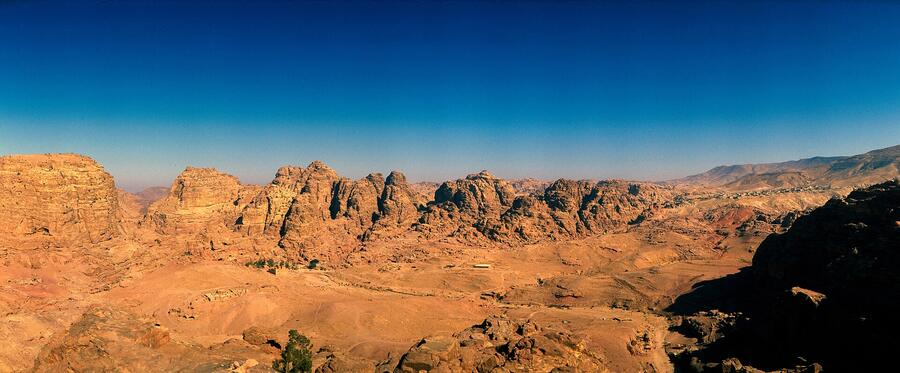
Explore Yourself · No. 09
Petra
A desert city whose temples and tombs were carved straight into rose-red sandstone cliffs
Ancient Herald pocket guide
At a glance
- Where
- Ma'an Governorate, southern Jordan; nearest town Wadi Musa, at the site's entrance
- Period
- c. 1st century BC–AD 4th century
- Time to allow
- One full day for the main trail and the Monastery. Two days let you add the High Place of Sacrifice and quieter side trails.
- Best time
- Spring and autumn, when days are mild. Start early: the Siq is cool and quiet, and the Treasury gets its best light in the morning. Summer middays are very hot, with little shade beyond the Siq.
The story
Petra was the capital of the Nabataeans, Arab traders who grew rich on caravan routes carrying incense and spices. In a hidden valley in the mountains, they carved tombs and temples straight into the red sandstone cliffs. They also built dams, cisterns and channels to store the winter rain, so a large city could thrive in the desert.
Rome annexed the kingdom in AD 106, and Petra stayed busy under Roman and later Byzantine rule. Changing trade routes and a severe earthquake in AD 363 began its long decline. The Swiss traveller Johann Ludwig Burckhardt brought it to European attention in 1812. It became a UNESCO World Heritage Site in 1985. Most of what survives are tomb facades. The houses of the living were built of stone and have mostly collapsed, so the city of the dead is what you walk through.
Through time
- 1st century BC–1st century ADUnder kings such as Aretas IV, the Nabataeans carved most of Petra's grandest monuments.
- AD 106The Roman emperor Trajan annexed the Nabataean kingdom and made it the province of Arabia.
- AD 363A severe earthquake destroyed many of Petra's freestanding buildings.
- 5th–6th centuries ADByzantine Petra was a bishop's seat, and several churches with mosaic floors were built.
- 1812Johann Ludwig Burckhardt, travelling in disguise, became the first European in modern times to describe the site.
- 1985UNESCO listed Petra as a World Heritage Site.
01
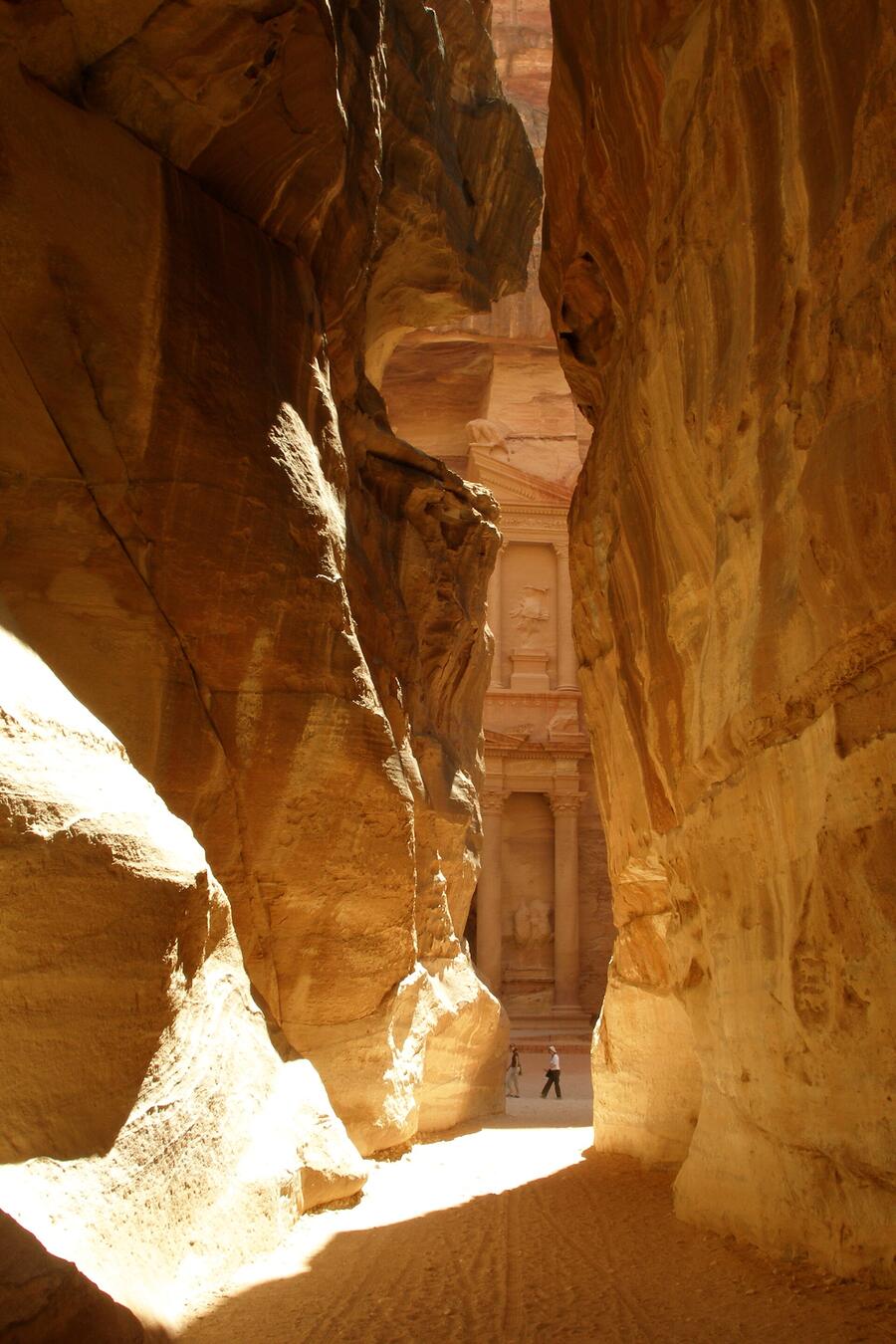
The Siq
The main way in is a winding gorge about 1.2 km long, split by tectonic forces and later worn by water. Look low along both walls for the rock-cut channels that carried water into the city. Most people miss the eroded relief of men leading camels, of which mainly the legs survive.
Tip Walk it early in the morning to have it nearly to yourself, and step aside for horse carts.
02
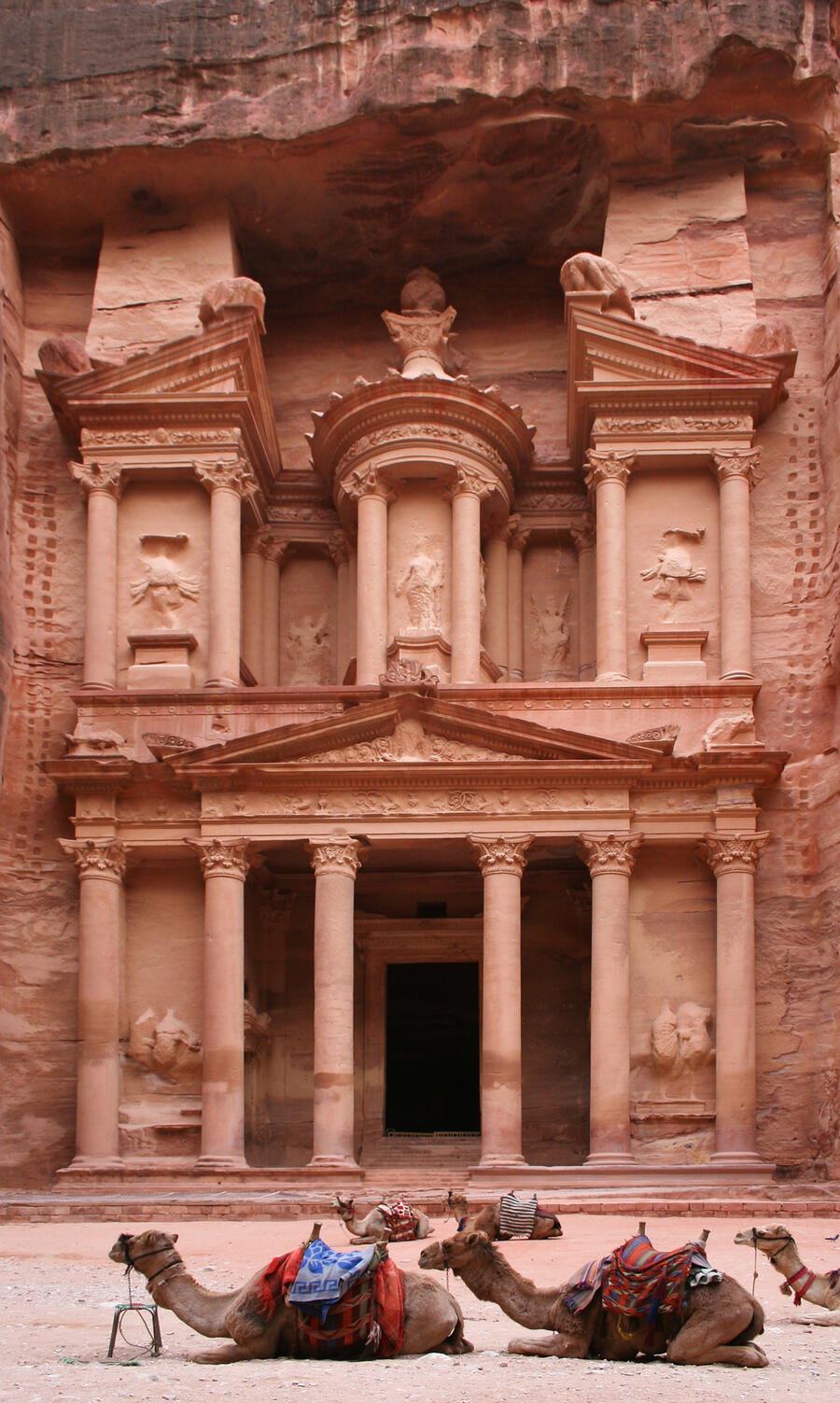
Al-Khazneh (the Treasury)
The Siq opens onto Petra's most famous facade, about 40 m high and carved in a mix of Greek and Nabataean styles. It was probably a royal tomb, often dated to the reign of Aretas IV. Look up at the stone urn at the top: it is pitted with bullet marks from people who believed it hid treasure.
Tip Come in the morning, when sunlight falls on the facade.
03
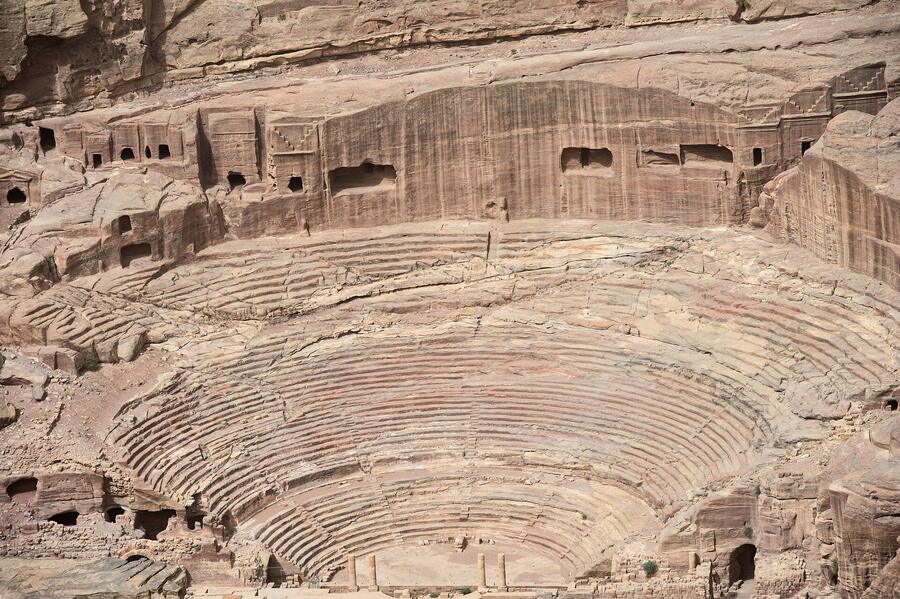
Street of Facades and the Theatre
Past the Treasury the valley widens between rows of tomb facades crowned with stepped decoration, a typical Nabataean motif. The theatre was carved into the hillside and enlarged after the Roman takeover. Look at the rock above the top rows of seats: the builders cut through older tombs, and their chambers now gape open.
04
Royal Tombs
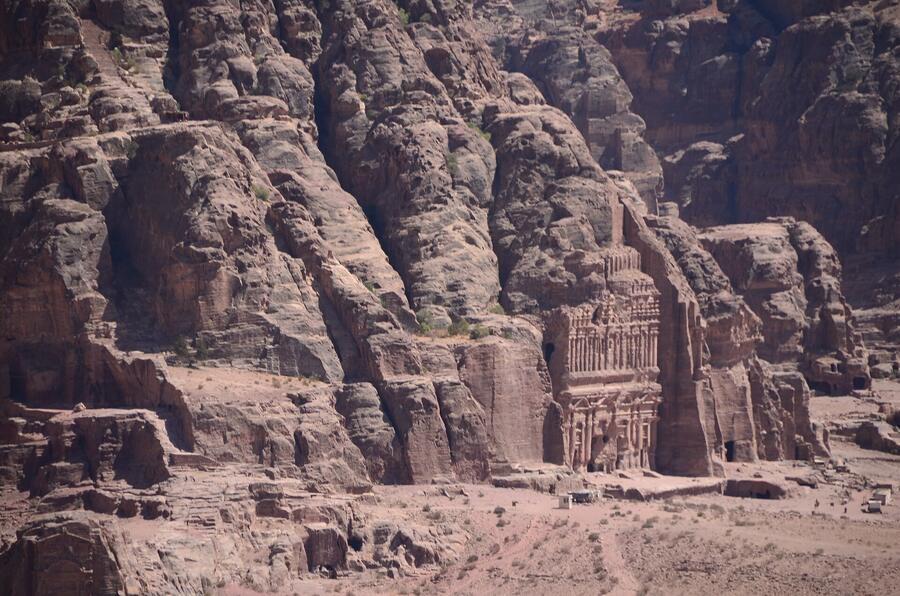
Four grand facades line the cliff of Jabal al-Khubtha: the Urn Tomb, Silk Tomb, Corinthian Tomb and Palace Tomb. An inscription records that the Urn Tomb became a church in AD 446. Most people hurry past the small Silk Tomb, but its face shows the brightest bands of red, yellow and white stone in Petra.
Tip The cliff faces west and glows in late afternoon light. Climb to the Urn Tomb terrace for a view over the city centre.
05
Colonnaded Street and Qasr al-Bint
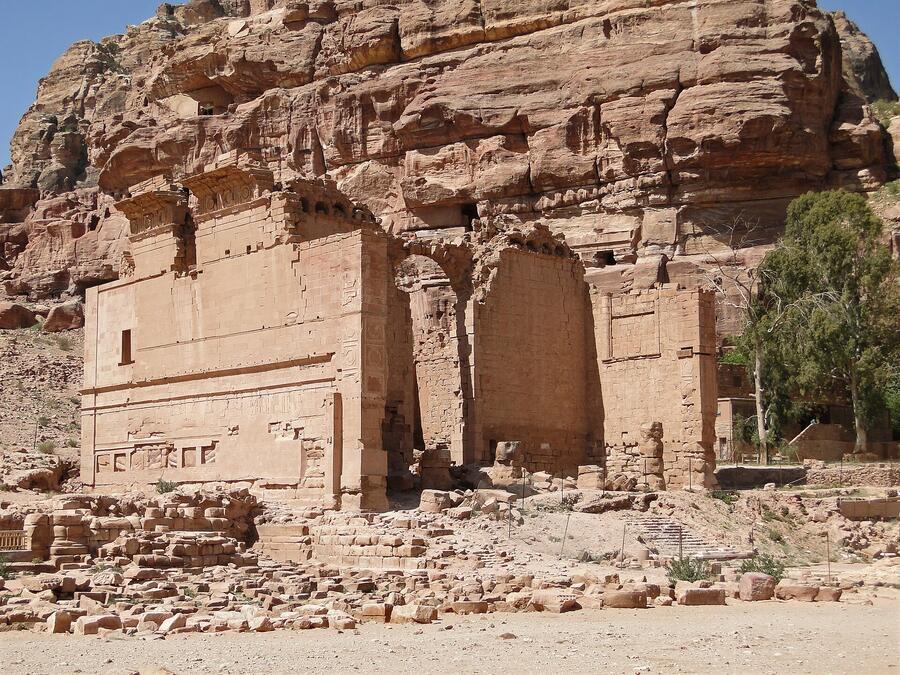
The paved street was the city's main avenue, lined with shops, the Great Temple and a monumental gate. At its end stands Qasr al-Bint, Petra's main temple, built of stone blocks instead of carved from the cliff. Look for the courses of wood set into its walls, which archaeologists think helped them absorb earthquake shocks.
Tip Detour up the slope north of the street to the Petra Church and its Byzantine floor mosaics of animals.
06
Ad Deir (the Monastery)
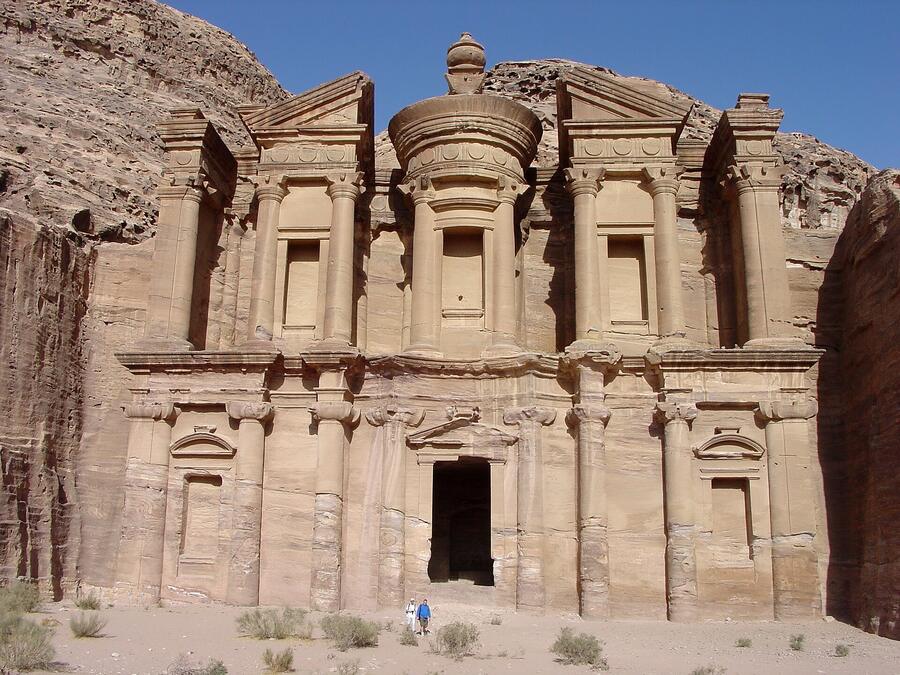
A path of about 800 rock-cut steps climbs to Petra's largest facade, nearly 50 m high and wide. Its plainer design echoes the Treasury on a bigger scale. Inside, look for crosses carved into the back wall in Byzantine times, which gave the building its name.
Tip The facade catches the afternoon sun. Walk a little beyond it to the viewpoints over Wadi Araba.
The museum
Petra Museum
Wadi Musa, beside the site entrance
It displays Nabataean fine ware: bowls painted with plant designs and thrown almost as thin as eggshell. Look also for betyls, the stone blocks the Nabataeans used to represent their gods, some carved with stylised eyes.
Nearby
- Little Petra (Siq al-Barid) A smaller Nabataean suburb a short drive north, with rock-cut halls, cisterns and a rare painted ceiling.
- Shobak Castle A Crusader castle founded in 1115 by King Baldwin I on a hilltop on the old road north of Petra.
- Wadi Rum A desert valley to the south with a Nabataean temple and thousands of ancient rock inscriptions and drawings.
Before you go
- Wear shoes with good grip: the sandstone steps are worn smooth and sandy.
- Carry more water than you think you need. Shade is scarce once you leave the Siq.
- For the classic view down onto the Treasury, take the trail that climbs above the Royal Tombs along Jabal al-Khubtha.
- Bring a hat and sun cream, and plan the Monastery climb for the cooler part of the day.
News from Petra and the rest of the ancient world, every day: ancientherald.com
Photos
- Petra seen from the High Place of Sacrifice: filmrausch.com, CC BY-SA 3.0 (source)
- The Siq canyon: Vyacheslav Argenberg, CC BY 4.0 (source)
- Al-Khazneh, the Treasury facade: Al_Khazneh_Petra.jpg : Graham Racher from London, UK derivative work: MrPanyGoff, CC BY-SA 2.0 (source)
- The Nabataean theatre: Dosseman, CC BY-SA 4.0 (source)
- The Royal Tombs: Freedom's Falcon, CC BY-SA 4.0 (source)
- Qasr al-Bint temple: Bernard Gagnon, CC BY-SA 3.0 (source)
- Facade of Ad Deir, the Monastery: Michael Gunther, CC BY-SA 3.0 (source)


Ancient Herald · Explore Yourself
Facts checked against standard references. Opening times and tickets change: check them locally before you go.