Pompeii: a pocket guide
A Roman town buried by Vesuvius in AD 79, with its streets, houses, shops and graffiti still in place.
Download the pocket guide PDF for your phone · 1.4 MB
Explore Yourself · No. 05
Pompeii
A Roman town buried by Vesuvius in AD 79, with its streets, houses, shops and graffiti still in place.
Ancient Herald pocket guide
At a glance
- Where
- Campania, Italy; beside the modern town of Pompei, about 25 km south-east of Naples
- Period
- 6th century BC–AD 79; at its richest from the 2nd century BC
- Time to allow
- 4–5 hours for the main sights; a full day to see more
- Best time
- Spring or autumn, arriving early in the day. The air is cooler, the light is softer and tour groups are fewer. Midsummer afternoons are hot, and the streets have little shade.
The story
Pompeii was a busy Roman town near the Bay of Naples. It began as an Oscan settlement and later came under Samnite control. It became a Roman colony in 80 BC. In AD 79 Vesuvius erupted and buried the town under several metres of ash and pumice. Many people escaped. The remains of more than 1,000 victims have since been found.
Because nobody rebuilt it, Pompeii keeps details of daily life that most Roman towns lost. Its streets still have bakeries, bars with built-in counters, painted houses, election notices and graffiti. Excavation began in 1748, and about two-thirds of the town is now uncovered. In 1863 Giuseppe Fiorelli poured plaster into hollows left by bodies in the ash. His casts show victims in their last moments. Pompeii is a UNESCO World Heritage Site, together with Herculaneum and Torre Annunziata.
Through time
- 6th century BCOscan-speaking people settle on a ridge of old lava near the mouth of the River Sarno.
- 80 BCAfter Sulla besieges the town in the Social War, Pompeii becomes a Roman colony.
- AD 62A strong earthquake damages much of the town, and repairs are still under way in 79.
- AD 79Vesuvius erupts and buries Pompeii, Herculaneum and Stabiae; Pliny the Younger later describes the eruption in two letters.
- 1748Excavations begin under the Bourbon rulers of Naples.
- 1863Giuseppe Fiorelli makes the first plaster casts of victims from hollows in the ash.
01
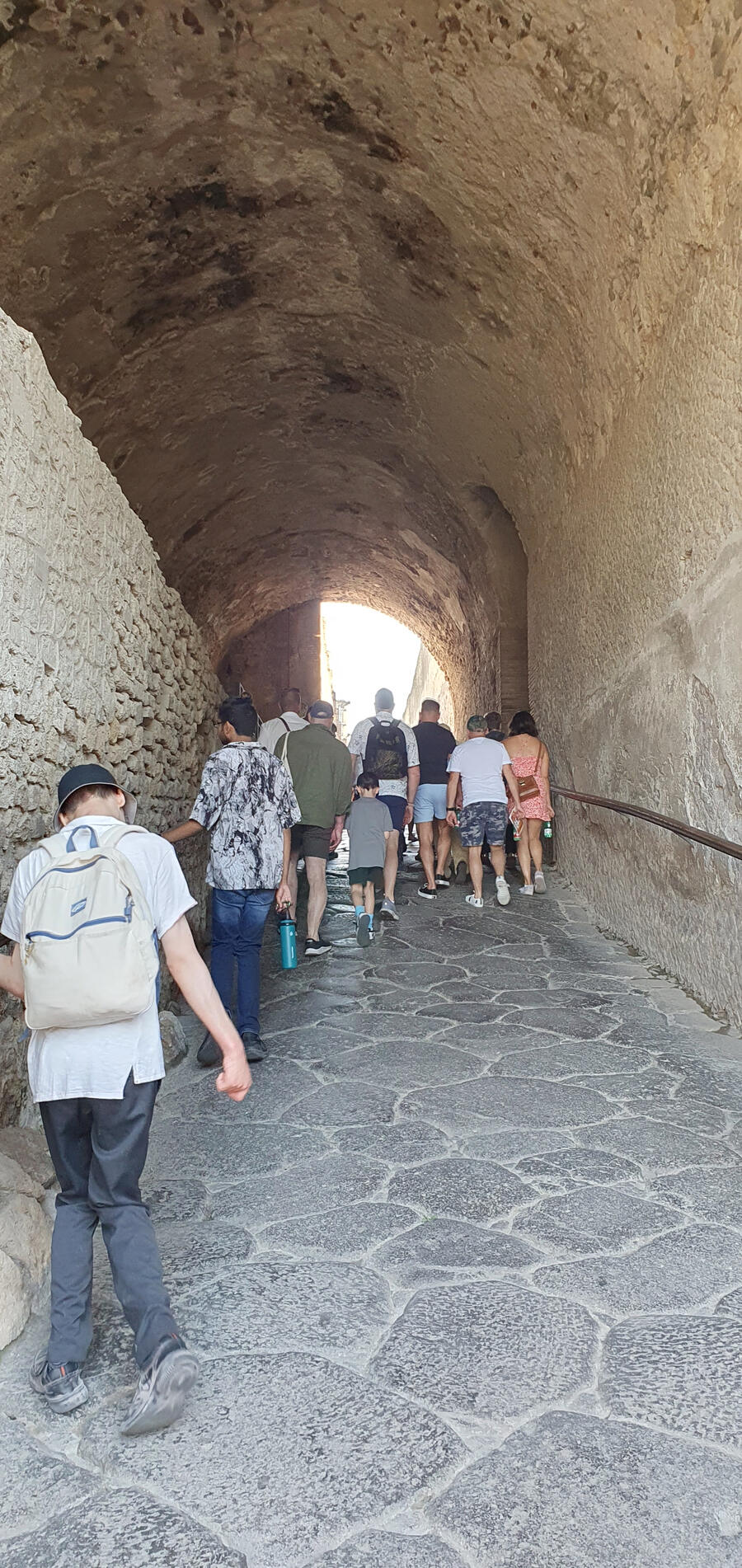
Porta Marina
The western gate has two vaulted passages: a small one for people on foot and a larger one for animals and carts. The steep ramp climbs the old lava ridge the town stands on. Most people miss the clue in the name: the gate faced the sea, and the coastline was much closer in AD 79.
Tip The paving is worn smooth and slopes steeply, so take it slowly, especially when wet.
02
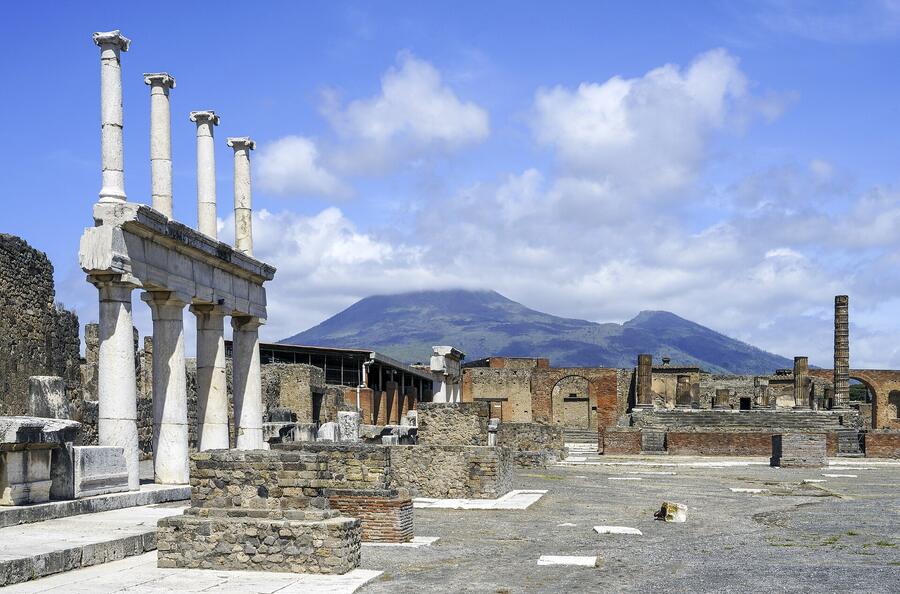
Forum
This long open square was the centre of public life, lined with temples, market halls and the Basilica (the law court). The Temple of Jupiter at the north end lines up with Vesuvius behind it. On the west side, many walk past the Forum granary, where stacked amphorae and several plaster casts sit behind railings.
Tip For the classic photo, stand at the south end of the square and frame the temple steps with the volcano.
03
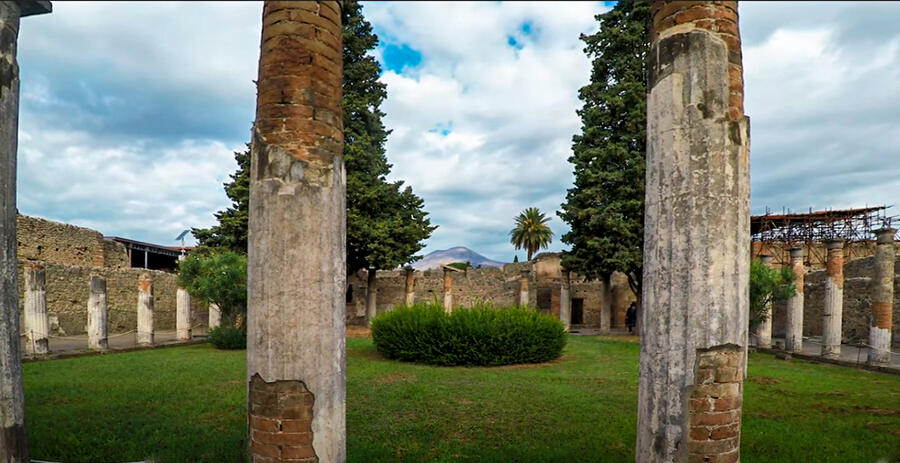
House of the Faun
One of the largest houses in Pompeii, it fills a whole block and dates from the 2nd century BC. The bronze dancing faun in the atrium is a copy, and so is the Alexander Mosaic between the two garden courtyards; the originals are in Naples. Look down at the pavement outside the door: coloured stones spell HAVE, a Latin greeting.
Tip It is a short walk north-east of the Forum along Via della Fortuna.
04
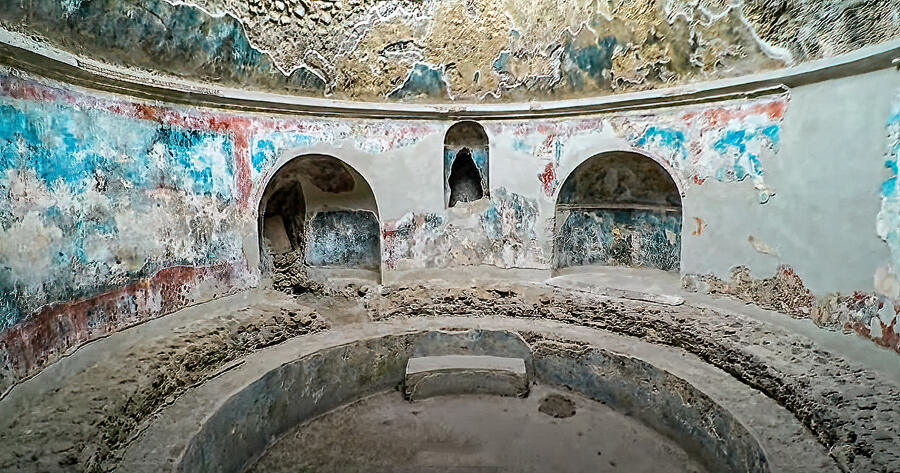
Stabian Baths
These are the oldest public baths in Pompeii, with separate sections for men and women. In the men's changing room, look for the wall niches where bathers left their clothes and the stucco on the vaulted ceiling. In the hot rooms, the floors rest on small brick pillars so that hot air from the furnace could flow underneath.
Tip On Via dell'Abbondanza, notice the raised stepping stones. People crossed on them, and cart wheels passed between them.
05
Theatre district
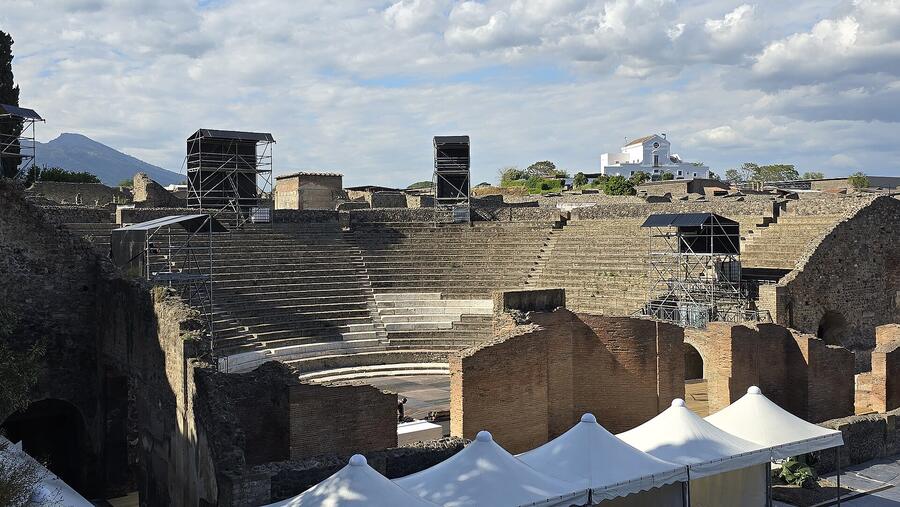
The Large Theatre is built into a natural slope, and the smaller Odeion beside it once had a roof for music and recitals. Behind the stage is a large colonnaded square, the Quadriporticus. After the earthquake of AD 62 it became barracks for gladiators, and decorated gladiator helmets were found there.
Tip The top rows of the Large Theatre are quieter and look down over the stage and the Quadriporticus.
06
Amphitheatre
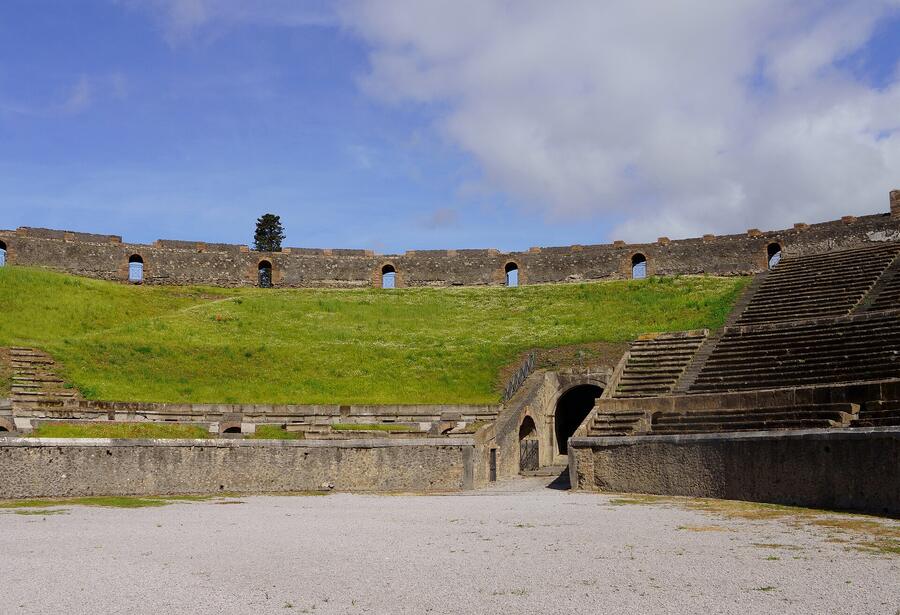
Built around 70 BC, this is the oldest surviving stone amphitheatre in the Roman world. In AD 59 a riot broke out here between Pompeians and visitors from nearby Nuceria. Rome banned games in the town for ten years, and a wall painting of the fight is now in Naples.
Tip Nearby, the Garden of the Fugitives holds casts of 13 people who died trying to escape.
The museum
National Archaeological Museum of Naples (Museo Archeologico Nazionale di Napoli)
Naples
The original Alexander Mosaic and the bronze Dancing Faun from the House of the Faun are both here, along with many wall paintings from Pompeian houses. Look for the fresco of the amphitheatre riot of AD 59 and the portrait of a Pompeian couple often identified as Terentius Neo and his wife.
Nearby
- Herculaneum (Ercolano) A smaller town buried by the same eruption, where wooden beams, upper floors and furniture survive.
- Oplontis (Torre Annunziata) A grand Roman villa with some of the finest wall paintings around the bay.
- Stabiae (Castellammare di Stabia) Large seaside villas, including Villa Arianna and Villa San Marco, on a ridge above the bay.
Before you go
- Wear firm shoes with good grip. The streets are paved with uneven basalt blocks, and the kerbs are high.
- Carry water and a hat. Shade is scarce on the streets, and the town covers about 66 hectares.
- Take a site map at the entrance and choose your stops before you set off, or you will spend the day walking.
- Leave time for the Villa of the Mysteries, outside the Herculaneum Gate at the north-west edge. One room has a painted cycle of life-size figures.
News from Pompeii and the rest of the ancient world, every day: ancientherald.com
Photos
- Forum of Pompeii with Vesuvius behind: No machine-readable author provided. Gaiusiulianus assumed (based on copyright claims)., Public domain (source)
- Porta Marina gate and city walls: Yair Haklai, CC BY-SA 4.0 (source)
- The Forum with Vesuvius behind: Commonists, CC BY-SA 4.0 (source)
- Rear peristyle of the House of the Faun: Mary Harrsch, CC BY-SA 4.0 (source)
- Men's frigidarium in the Stabian Baths: Mary Harrsch, CC BY-SA 4.0 (source)
- Large Theatre of Pompeii: Rigorius, CC BY-SA 4.0 (source)
- Arena inside the Amphitheatre: Commonists, CC BY-SA 4.0 (source)


Ancient Herald · Explore Yourself
Facts checked against standard references. Opening times and tickets change: check them locally before you go.