Stonehenge: a pocket guide
Giant sarsen stones capped with lintels, raised about 4,500 years ago and set to the midsummer sunrise and midwinter sunset.
Download the pocket guide PDF for your phone · 1.2 MB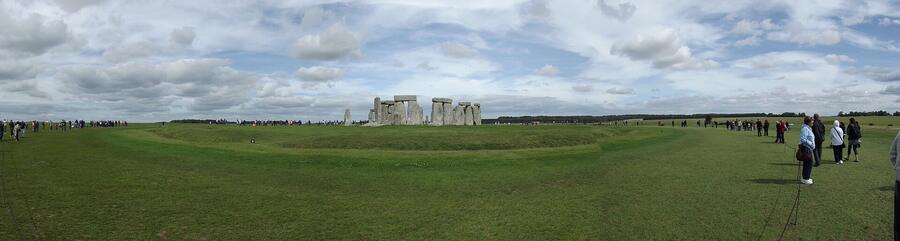
Explore Yourself · No. 10
Stonehenge
Giant sarsen stones capped with lintels, raised about 4,500 years ago and set to the midsummer sunrise and midwinter sunset.
Ancient Herald pocket guide
At a glance
- Where
- Salisbury Plain, Wiltshire, England, United Kingdom; about 3 km west of Amesbury
- Period
- c. 3000–1500 BC
- Time to allow
- 2 to 3 hours, including the exhibition and the walk to the stones
- Best time
- Spring or autumn, early morning or late afternoon. Low sun brings out the earthworks and carvings, and there are fewer coach groups. In winter the sun sets along the monument's main axis.
The story
Stonehenge is a prehistoric monument on Salisbury Plain, built and rebuilt over about 1,500 years. It began around 3000 BC as a circular ditch and bank, with cremation burials. Around 2500 BC builders raised the great sarsens. These sandstone blocks came from about 30 km north and average around 25 tonnes. Among them stand smaller bluestones, brought some 240 km from the Preseli Hills in west Wales.
The monument's axis points to sunrise at midsummer and sunset at midwinter. It is the only surviving stone circle in the world with lintels. Builders shaped the stones with stone hammers and fixed the lintels with joints used in carpentry. Nobody knows exactly what ceremonies took place here. Stonehenge stands among hundreds of prehistoric burial mounds and other monuments. With Avebury, it became a UNESCO World Heritage Site in 1986.
Through time
- c. 8000 BCHunter-gatherers raised a row of large pine posts close to where the stones now stand.
- c. 3500 BCFarmers dug the Cursus, a long ditched enclosure nearly 3 km long, just north of the later monument.
- c. 3000 BCA circular ditch and bank were dug, and cremated human remains were buried in and around the enclosure.
- c. 2500 BCThe sarsen circle and the five trilithons were raised, with the bluestones set among them.
- c. 1600 BCThe last known work took place: two rings of pits were dug around the stones.
- 1986Stonehenge and Avebury were listed together as a UNESCO World Heritage Site.
01
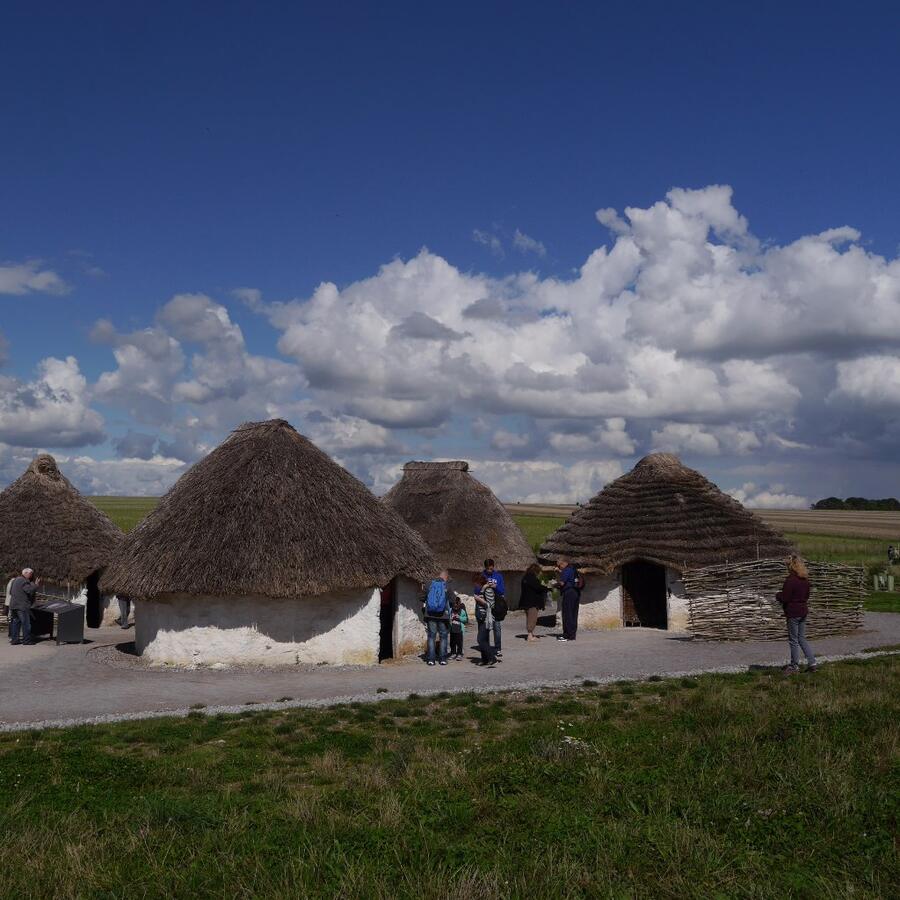
Visitor centre and Neolithic houses
The exhibition sets out the monument's building phases and shows finds from the area. Outside stand reconstructed Neolithic houses, based on house floors excavated at Durrington Walls. Many people miss the full-size sarsen on a wooden sledge beside them, a test of one way the stones may have been moved.
Tip The visitor centre is about 2.5 km west of the stones. See the exhibition first, so the phases make sense on site.
02
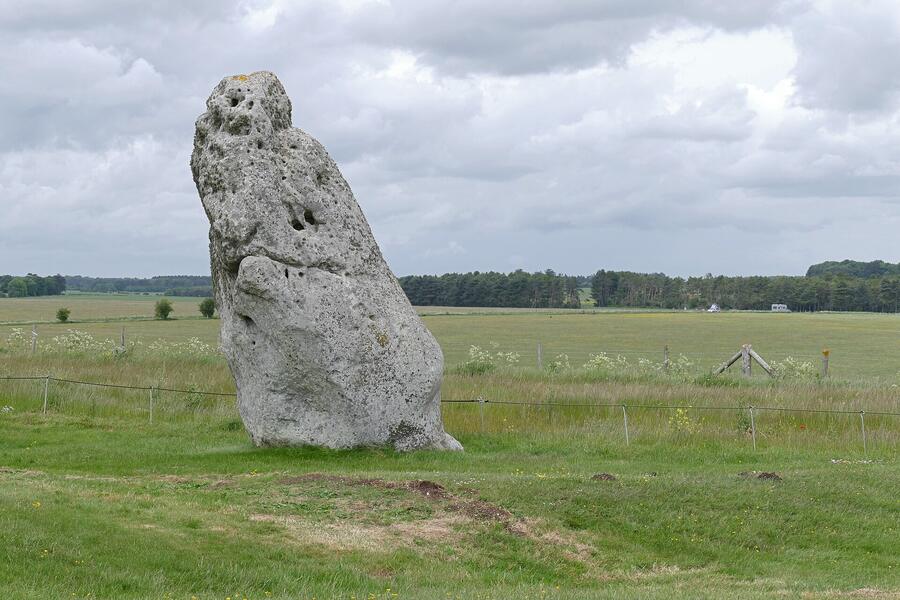
The Heel Stone and the Avenue
The Heel Stone is a large, unshaped sarsen just outside the earthwork. Seen from the centre of the circle, the midsummer sun rises close to it. Beyond it run the faint parallel banks of the Avenue, which leads about 2.5 km to the River Avon.
Tip The Avenue banks show best in low sun or after a frost.
03
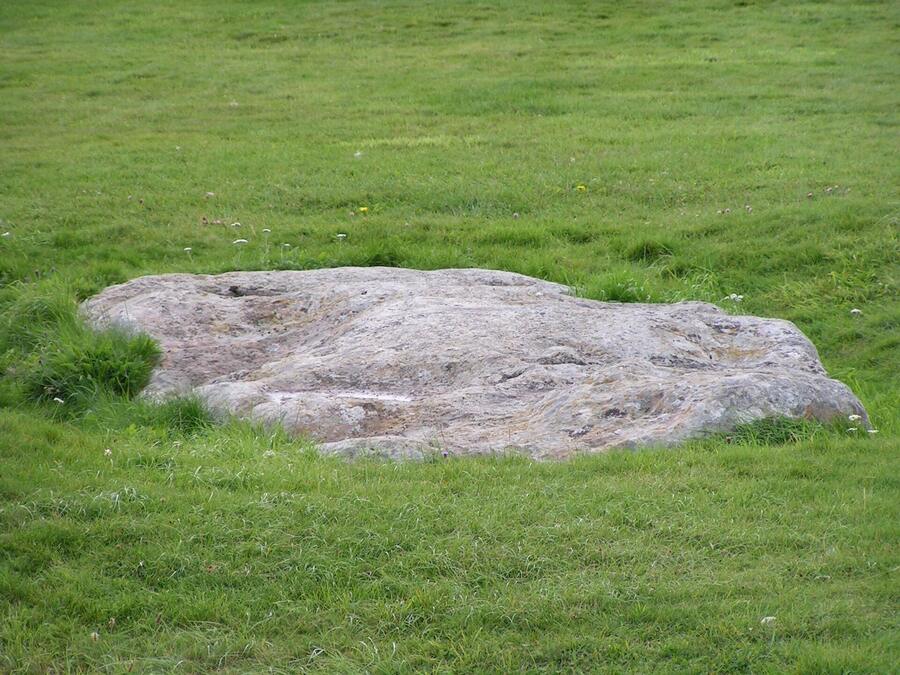
The entrance and the Slaughter Stone
The main entrance through the bank faces north-east, in line with the Avenue and the Heel Stone. The large fallen sarsen here is the Slaughter Stone. Rainwater in its hollows turns rust-red from iron in the stone, which helped give it its gory name.
04
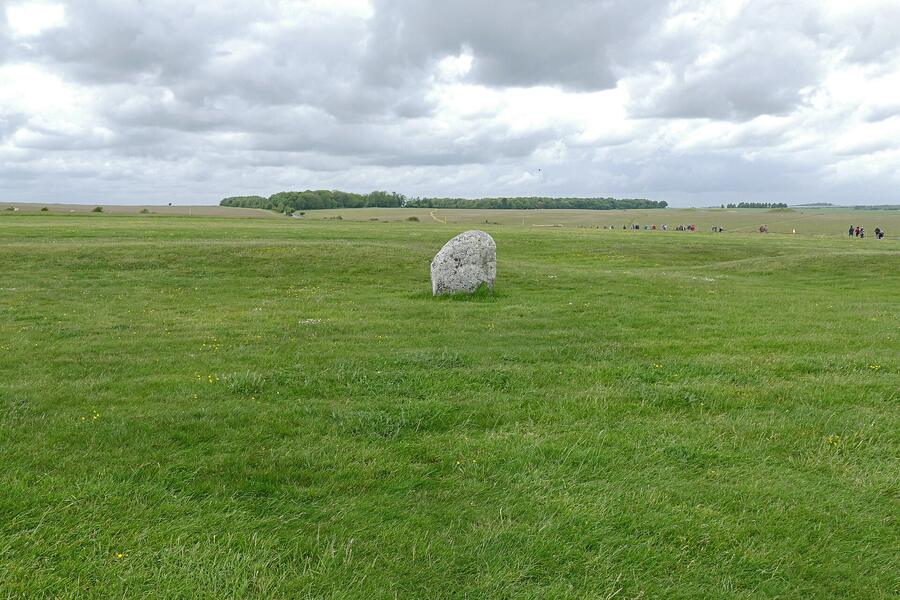
The ditch, bank and Aubrey Holes
The low bank and ditch are the oldest part of the monument, dug around 3000 BC with red deer antler picks. Just inside the bank lay a ring of 56 pits called the Aubrey Holes, which held cremated human remains. Look for the two surviving Station Stones near the bank: one stands and one lies flat.
Tip Several Aubrey Holes are marked by white discs in the grass.
05
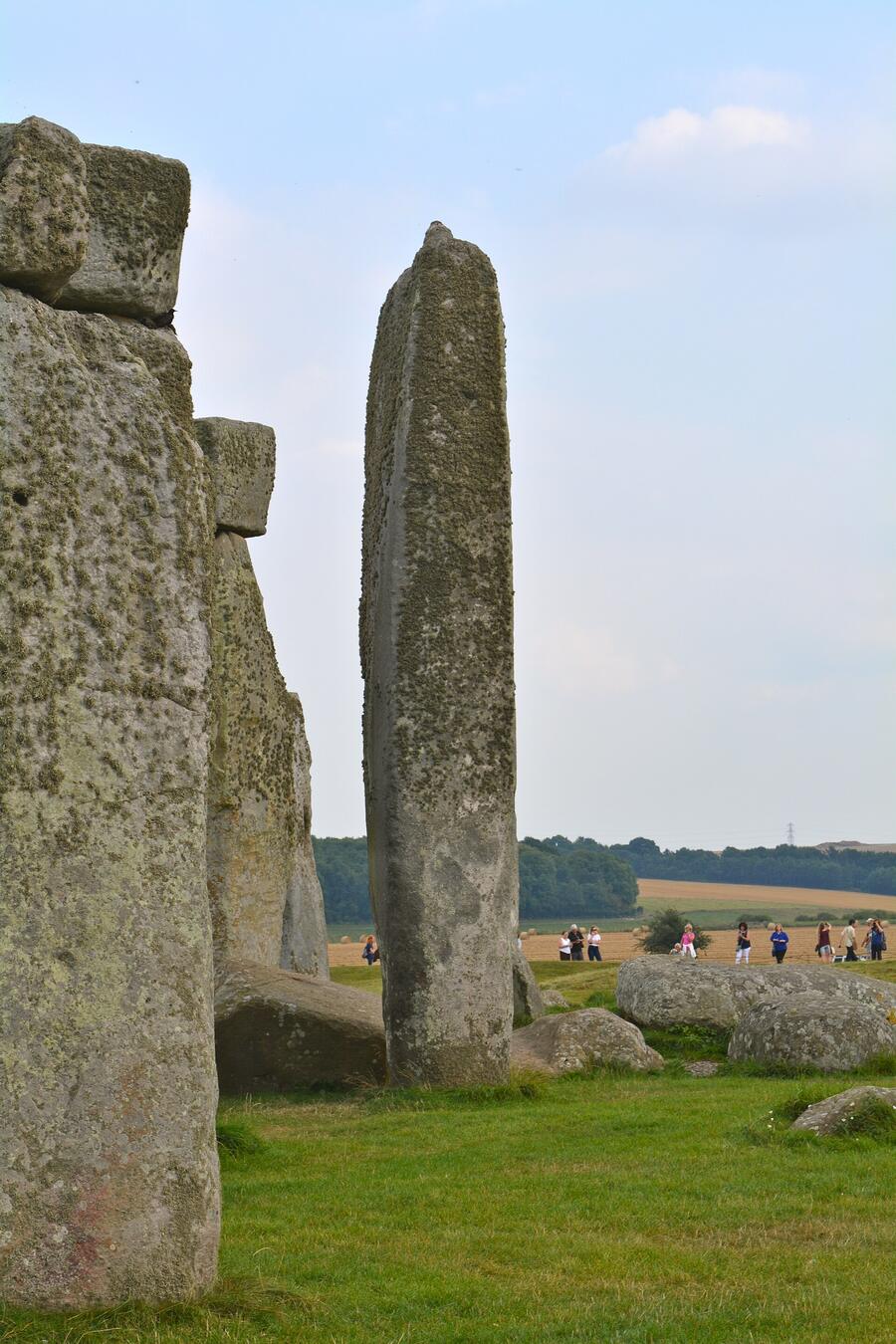
The sarsen circle and lintels
The outer ring had 30 uprights carrying a continuous ring of lintels. Each lintel sat on knobs on top of the uprights, fixed in sockets (a mortise-and-tenon joint), and locked to the next lintel with tongue-and-groove joints. Where a lintel has fallen, look for the knob still standing proud on top of the upright.
Tip The lintels curve gently to follow the circle. You see this best from a slight angle, not head-on.
06
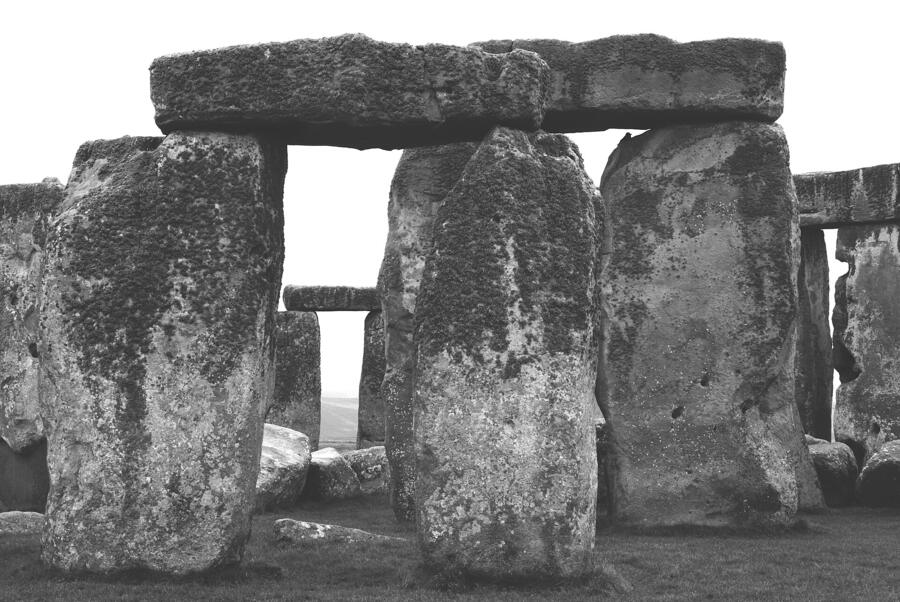
The trilithons and bluestones
Inside the circle, five trilithons (two uprights and a lintel) form a horseshoe that opens to the north-east. They rise in height towards the centre, and the smaller bluestones from west Wales stand among them. Most visitors miss the Bronze Age carvings of axe-heads and a dagger on stone 53, faint except in low side light.
Tip Bring binoculars for the carvings.
The museum
Salisbury Museum (Wessex Gallery)
Salisbury
The gallery shows the Amesbury Archer, a man buried near Amesbury around 2300 BC with copper knives, archery equipment and gold hair ornaments. It also holds the Stonehenge Archer, found in the monument's ditch with flint arrowheads among his bones.
Nearby
- Durrington Walls and Woodhenge A huge henge about 3 km north-east where excavators found houses of around 2500 BC, with Woodhenge's post rings marked out beside it.
- Avebury The largest stone circle in Britain, with a village inside it, and Silbury Hill and West Kennet Long Barrow close by.
- Old Sarum An Iron Age hillfort above Salisbury, later the site of a Norman castle and the first cathedral.
Before you go
- Wear sturdy shoes. The grass paths around the stones and across the fields turn muddy after rain.
- Salisbury Plain has no shade and little shelter. Bring water, sun protection and a windproof layer.
- For the classic view, stand on the north-east side and look along the Avenue, through the entrance, to the circle.
- Walk at least one way between the visitor centre and the stones, about 2.5 km over open fields. The route passes groups of Bronze Age burial mounds.
News from Stonehenge and the rest of the ancient world, every day: ancientherald.com
Photos
- Panoramic view of Stonehenge: Derek Jensen, CC BY 2.0 (source)
- Replica Neolithic houses at the visitor centre: Rich Tea, CC BY-SA 2.0 (source)
- The Heel Stone: Alan Hunt, CC BY-SA 2.0 (source)
- The fallen Slaughter Stone: Stefan Kühn, CC BY-SA 3.0 (source)
- A Station Stone: Alan Hunt, CC BY-SA 2.0 (source)
- Tenon on top of Stone 56: TobyEditor, CC BY 4.0 (source)
- Close view of the great stones from the rope line: Peter Trimming, CC BY-SA 2.0 (source)


Ancient Herald · Explore Yourself
Facts checked against standard references. Opening times and tickets change: check them locally before you go.