Stone Age · c. 10,000–5500 BC · Umm Araka Plateau, near Serabit el-Khadim, South Sinai, Egypt
Rock shelter with prehistoric animal paintings found in Egypt's southern Sinai
Red animal paintings on the ceiling of a sandstone shelter near Serabit el-Khadim open a sequence of images that runs into the Islamic period.
Official announcement
Umm Araka Plateau, near Serabit el-Khadim, Egypt An Egyptian mission from the Supreme Council of Antiquities has documented a previously unknown sandstone rock shelter in southern Sinai. It lies on the Umm Araka Plateau. The shelter's ceiling carries red paintings of animals. The team provisionally dates them to between the tenth millennium and 5500 BC.
People added engravings and inscriptions over the following millennia. These continue through the Nabataean period and into the Middle Ages.
Egypt's Ministry of Tourism and Antiquities announced the find in February. The minister, Sherif Fathy, described it as a first-rate addition to the Egyptian archaeological map.
Hisham El-Leithy is Secretary-General of the Supreme Council of Antiquities. He said the plateau should be considered an open-air natural museum. His reason was the range of dates and techniques in its paintings and inscriptions. The site's name appears as Umm Araka in some reports and Umm Arak in others.
A lookout near the Serabit el-Khadim mines
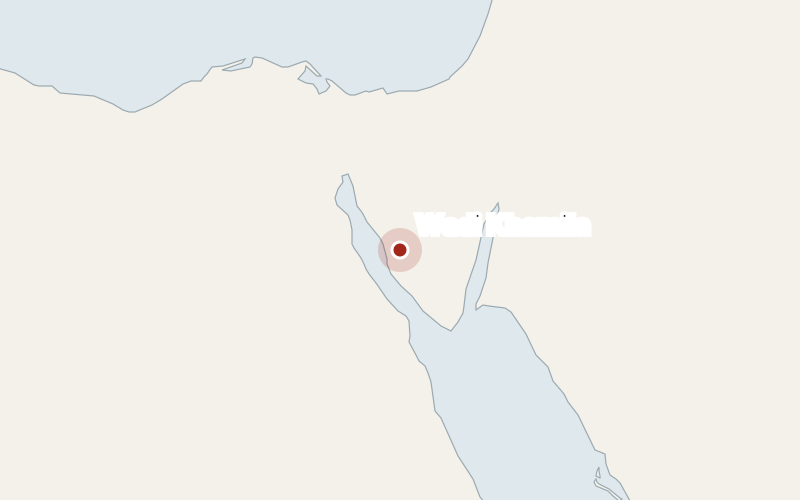
The plateau lies in a sandy area. It is about 5 kilometres northeast of the Temple of Serabit el-Khadim and the ancient copper and turquoise mining areas around it. Serabit el-Khadim is best known for its temple to the goddess Hathor. It is also known for the turquoise mines worked by pharaonic expeditions.
From the plateau, the view runs north across a broad plain towards the El Tih plateau. The team thinks the site served over time as a lookout, a gathering place and a resting point. It would have served people travelling this route.
The mission found the shelter during a systematic survey of rock art in southern Sinai. A local resident guided the team to it: Sheikh Rabie Barakat from the Serabit el-Khadim area.
A rock shelter is a shallow natural overhang in a cliff face. This one stretches for more than 100 metres along the eastern flank of the plateau. It is 2 to 3 metres deep. Its roof drops from about 1.5 metres near the entrance to about half a metre further in.
From red paintings to Arabic inscriptions
The red paintings on the ceiling are the oldest group, according to the preliminary sequence. They show animal species of the region in prehistoric times. Next to them are signs whose meaning is still being studied.
The team based these dates on style and technique. The announcement does not mention any scientific dating method.
The mission also recorded a second group of paintings in a greyish colour. This variant had not been documented in the area before. The announcement gives no date for these paintings.
A later phase consists of deeply incised engravings. One shows an archer stalking an ibex with several dogs at his side.
The two published accounts differ on where this scene sits. Archaeology News describes it alongside the oldest images. La Brújula Verde's account of the team's sequence places it after the red paintings.
Further engravings show dromedaries and horses, some ridden by armed figures. In some cases they appear next to inscriptions in Nabataean script. The Nabataeans are best known for Petra in present-day Jordan. They flourished between about 400 BC and AD 200.
The latest material is a series of Arabic inscriptions from the early centuries of Islam and the Middle Ages. Archaeology News dates the late antique and medieval inscriptions and drawings to roughly the sixth to fifteenth centuries AD.
Geometric signs appear throughout the shelter. They include X shapes, squares, ovals and crescents.
Work inside the shelter found thick deposits of animal dung. The team reads this as evidence that people and livestock sheltered there from rain and hail in later periods.
Low stone walls divided the space into small living units. In their centres were layers of ash and burnt material from hearths.
Flint tools and pottery sherds came from the shelter and the surrounding area. Preliminary study assigns some of the pottery to Egypt's Middle Kingdom. It assigns some to the Roman period, in the third century AD.
Study of the images will continue over the coming months. The team aims to refine the dating of each group. It also plans to draw up a plan for documenting and protecting the site.
Sources
Spotted a mistake? Tell the editor about a spelling error or a fact that is wrong. We correct stories openly.
Readers' picks show on the front page.
Follow @AncientHeraldHQ on X for the day's finds as they come in.


Comments
House rules. Stay on the subject, be kind to other readers and say where your facts come from. No advertising and no personal attacks. The editor reads along and hides comments that break these rules.
Loading comments…